Latest Posts

Fair Maidens and Cowboys – Part 1

Stockholm has a lively drinks and restaurant scene. Nevertheless, the city is fairly small and consequently the number of trade and tasting events that occur here are quite limited. Earlier this month, however, not only one but two tasting events took place in the same week – luckily not on the same day. Each set up was totally different in style to the other.

The first event was organised by Lars Torstenson and his team at Terrific Wines. A charismatic, maverick Swedish winemaker, he spent many years in the South of France producing idiomatic wines. Nowadays, as well as making wine, he consults all over the world and imports wine to Sweden. And he writes, quite a bit, mostly books on wine. He also publishes a daily blog (www.vinifierat.se), humourous, rock’n’roll, at times irreverant yet topical. In the second week of March he showcased a selection of his wines. He did better than that however, he invited winemakers along to present them. He may also be promoting women and wine, or maybe he simply enjoys women’s company, who knows: all of the chosen winemakers were women. Terrific at that, as were the wines.

The programme started off with an introduction from Louise Sydbeck on her journey to becoming Sweden’s 3rd Master of Wine. This was followed by a presentation on Skype from Andrea Mullineux, winemaker at Mullineux Family Wines, Swartland, South Africa.

SWARTLAND – LOVING THIS LAND

Andrea and her husband Chris Mullineux are part of a small group of winemakers which include amongst others Eben Sadie and Adi Badenhorst that have brought attention to Swartland. Swartland, literally black land, owes its name to its indigenous rhino bushes (renosterbos) that turn black during the summer. Located an hour’s drive away from Cape Town, the region is primarily agricultural (wheat) but has 13’509 ha of vines. Swartland is South Africa’s fourth biggest wine region, after Stellenbosch (1st), Paarl (2nd) and Robertson (3rd), with 13.55% of total hectares of vines (figures for 2013 from SAWIS annual statistics at http://www.wosa.co.za).

Mullineux wines

Mullineux Family Wines: An artful declension of Syrah

Andrea, a trained oenologist from California, explained how she came to South Africa 11 years ago for an internship and fell in love with the country. She met her husband whilst working in the Rhône Valley and both are passionate about Rhône varietals. She and her husband worked at Tulbagh Mountain Vineyards (now Fable Mountain Vineyards) but in 2007 they decided to set up their own winery. As a young couple starting off they did not have sufficient funds to buy land and plant vines. Instead they took over some old vines and brought them back to life. Their vineyards lie on soils of schist and granite and on the tiniest patch of iron, and are some of the most ancient viticultural soils on earth, formed over 550 million years ago.

With her hands still stained from grape processing, Andrea tells us how she is searching for purity of fruit and terroir in her wines. They have one red varietal, Syrah, with which they make four different wines. Three of the wines are made from grapes grown on one soil type only, i.e. Schist Syrah, Granite Syrah and Iron Syrah, with the fourth red a blend of all three soil types. Each wine is truly distinct from the other and a true expression of the soil type. On schist, water runs right off and the vines struggle. The berries are smaller and their skins thicker. The wines are masculine in style with more tannins and structure. Although the climate is mediterranean and rain falls only in the winter, the granite soils have a higher water table. The vines have a greater canopy and the bunches are bigger. Granite Syrahs are characterized by their perfume and elegance. Winemaking is as intervention free as possible. Andrea strives to make wines with structure – the key to longevity – and wants “texture that will age and not structure that will integrate”. She thus favours whole bunch fermentation and can leave the stems and skins on the juice for up to six weeks. She does not fear extracting too many tannins as she says that over time they soften and that in any case Swartland tannins can sometimes be too supple. She likes using bigger barrels such as 500 litre and 2000 litre foudres as she is interested in the wood for ageing and not for flavouring her wines. Wines mature between 9 and 18 months in wood. They are bottled unfiltered and unfined. Winemaking will of course vary from vintage to vintage, but within the same year each wine be it the Schiste, Granite or Iron will be vinified in the same way to let the expression of terroir shine through.

Mullineux Syrah 2013 tasting note: Dark raspberry in colour, gem-like luminosity, liquorice, raspberry sweets, freshness, elegance, supple, dry and long finish (ed.). 2013 was a cool vintage with long slow ripening which produced very aromatic wines. Andrea also mentioned that the stems were very ripe making the wines taste cooler.

Mullineux Schiste Syrah 2012 tasting note: Beautiful pinkish/plum colour, dense sweet raspberry fruit, blue fruit, plum, refreshing acidity, silky body, long dry and focused finish (ed.). 

Mullineux Granite Syrah 2012 tasting note: Violets, a little baked fruit, white pepper, spice, fresh, light and elegant, long mineral finish (ed.).

Mullineux Syrah Iron 2012 tasting note: Earthy and rich, a little rustic, toasty with dark fruit, peppery tannins, fullness on the mid-palate, good acidity, dry finish (ed.).

Andrea likes her wines to be fragrant with a spicier palate for enhanced aromatics. Indeed, all these reds were characterised by their expressive aromatics, freshness, fragrance, structure and lightness in body. When the Mullineuxs first started making these wines in 2007 the trend was for bigger and bolder wines. Now, however, tastes appear to be changing and although they are “not making wine for the critics, critics like their wines”.  In 2014 they were voted best South African winery of the year.


Bourgogne Blanc, Clotilde Davenne

Sea shells and Bourgogne Blanc, Clotilde Davenne

The next seminar was given by Clotilde Davenne who travelled over from Burgundy. A trained oenologist she worked for many years at Domaine Brocard in Chablis before setting up on her own. She is based in Préhy, just south of Chablis. Her vineyards are spread over a few communes including Chablis, St-Bris and Irancy. She produces quite a range of wines: red wine from Pinot Noir (Irancy), white Sauvignon Blanc (St-Bris), Chablis Premier Cru, Chablis Grand Cru, Chablis, Petit-Chablis and some sparkling Crémant de Bourgogne (rosé and white). Also in her portfolio is white, Aligoté and red Bourgogne.

The wine she presented was her Bourgogne Blanc. The grapes that go into the making of this wine come from vines situated near Préhy, bordering the Chablis appellation. They are at an elevation of 340m on kimmeridgian soil. Although not in the Chablis appellation, the style of the wine is in keeping with Chablis. It is fresh, pure, mineral and citrusy but with a softer, rounder palate. The wine is of excellent quality and very good value for money.

The grapes are harvested two weeks later than those from her other vineyards. The harvest is carried out by machine (ed. a clear demonstration that quality wine can be made from mechanically harvested grapes). The grapes are pressed as soon as they reach the winery. Racking (débourbage) for Clotilde is an important step: if too much solid matter is removed from the juice the fermentation will not have sufficient support, but if too much is left in, the final wine will not be elegant. Fermentation is spontaneous with no added yeast and there is no use of oak. After the first fermentation the wines go through malolactic fermentation, a process that gives complexity to the wines.

Clotilde Davenne took us through different vintages, giving us a brief overview of the weather and its influence on her wines.

2012 was a classic vintage. There was a lot of rain and it was hard to stay organic. The rain stopped at the end of July. August and September were good. 2012 turned out to be a very good vintage for Chablis, producing wines with a nice acidity and concentration.  The Bourgogne Blanc 2012 is fresh, citrusy, with a touch of butteriness and apples on the mid-palate.

In 2010 the weather was nice throughout the year. There was just the right amount of sun and rain. The Bourgogne Blanc 2010 is characterised by good minerality, racy length and a little toastiness (ed.). Clotilde points to the taste of almonds indicating the wine’s ability to age. She adds that the citrus character has left as the wine is now going through a period of ageing.

2009 was a hotter vintage. Clotilde says that it is hard to tell how well the wines will age – acidity being the main component necessary for the ageing of white wines. Clotilde’s Bourgogne Blanc 2009 is rounder and fuller in the mouth than the 2010 and has notably less acidity (ed.).

2008 is an interesting vintage. It was a difficult year. The month of August was awful. It was very cold. The grapes were harvested at the end of September, as in the past. The acidity was very high. The malolactic fermentation took place late, in May and June. The wines turned out to be amazing but were very closed in their youth. The Bourgogne Blanc 2008 is round on the palate with toasted notes and a long length (ed.).

In 2006 the summer was not particularly good and Clotilde started harvesting earlier. Her Bourgogne Blanc 2006 has a pronounced nose of yellow apples and soft, fleshy apples on the palate.

We were not poured the 2013 Bourgogne Blanc. This wine is on the shelves at Systembolaget (SB 5562) for SEK 127. Young, fresh, pear, grapefruit and peach on the nose and on the palate zesty lemon, high acidity, fleshy minerality and good length (ed.).

Clotilde’s outlook for the future of wine growing in Chablis is not hugely optimistic:  every year 10-15% of her plants die and have to be replaced. The diseases that afflict them include Flavescence Dorée, Bois noir and Esca, for which there is currently no cure. Climate change of course is the main worry. Will Chablis winemaking be able to continue relying on naturally produced acidity in the grapes?


Montagny 1er cru

Montagny 1er Cru “Les Coères”, Domaine Feuillat-Juillot, Bourgogne

Also from Burgundy but producing a different style of wine is Françoise Feuillat-Juillot. She bought her 14ha estate in 2004 and since then has been putting her personal stamp on the wines the estate produces: as well as being the winemaker she manages the vineyards. This she does in lutte raisonnée (Integrated Pest Management). The estate is located in the south of the Côte Chalonnaise, which has the Côte de Beaune above it and the Mâconnais below. Of her 14 hectares, four are them are Montagny Premier Cru, Les Coères. The vineyard is 60 years old, well situated, on an east/south-east facing plateau at an altitude of 300 m. Oak barrels are used for both the alcoholic and malolactic fermentation. 10% of the oak barrels are new, 50% are 1 to 2 years old and 40% are 3 to 4 years old. The hallmark of Montagny is its mineral character.

2013 Montagny 1er Cru “Les Coères”, Domaine Feuillat-Juillot. Tasting note: Delicate aromas of lime, grapefruit and white flowers. Fresh acidity and minerality on the palate (ed.) Not a vintage to cellar. The winter was long, spring was cool with rainstorms in May. Weather was bad during flowering and fruit set which reduced the crop. Rain fell during the month of September making it difficult for the vignerons to choose a harvest date and obliging them to work fast and diligently to achieve quality.

2012 Montagny 1er Cru “Les Coères”, Domaine Feuillat-Juillot. Tasting note: Citrus fruit and a hint of vanilla on the nose, fresh and elegant on the palate with a little saltiness (ed.). The weather was bad at flowering and produced small berries. On the 30th of June a huge storm struck the area. Yields were low – Françoise produced less than half her average yearly amount of wine – but there is quality. Wines have a good concentration.

2011 Montagny 1er Cru “Les Coères”, Domaine Feuillat-Juillot. Tasting note: Fresh, floral nose, white and yellow peaches. Cooked pears, almonds on the palate and a long length (ed.). Spring came early and was very warm and caused vine development to be three weeks early. Summer brought chaos with cold temperatures (one of the coldest summers of the last 20 years), rain and storms including hail in July. Production was not very big. In fact the crop for 2012 and 2011 put together corresponded to that of one average year. The wines displayed nice minerality and acidity but needed bâtonnage (lees stirring) to get more concentration.

2010 Montagny 1er Cru “Les Coères”, Domaine Feuillat-Juillot. Tasting note: Delicate and refined, citrus and lime on the nose, good acidity on the palate with a light and fresh body (ed.). A very good vintage for Burgundy, a “classic” vintage, that produced wines of great purity and freshness.

2009 Montagny 1er Cru “Les Coères”, Domaine Feuillat-Juillot. Tasting note: Powerful nose, ripe citrus and on the palate balanced acidity, round body, toasted almonds, baked apple pie, long length (ed.). Weather conditions were good throughout the vine’s growing season. The seasons were as expected. Temperatures were high during August and September. Yields were good and quality was exceptional. Françoise did not do any bâtonnage (lees stirring) on her wines as length and complexity were already there. A beautiful vintage deemed a real success in Burgundy. Wines have a good ageing potential.

2004 Montagny 1er Cru “Les Coères”, Domaine Feuillat-Juillot. Tasting note: Ripe fruit on the nose, good acidity, white flowers and pear on the palate. A year where yields had to be controlled with ébourgeonnage (bud removal) in the spring and green harvest in the summer. Mixed weather during the summer with hailstorms that damaged the vines. Slow maturation. Warm and dry month of September. Acidity came out high in the wines and bâtonnage (lees stirring) was necessary. Wines from this vintage are a little like those from 2010: very pure but with a medium length on the palate.

Pushing the limits – Grape growing and winemaking in Sweden

A few weeks ago I met successful asset manager Christer Wachtmeister for a coffee in Stockholm. The reason for visiting him was to find out about his hobby: grape growing and winemaking in Sweden. If some years ago the idea that grapes could grow in Sweden might have seemed far-fetched, today with global warming and a thriving sparkling wine production in the United Kingdom, Swedish wine comes as no real surprise.

According to the Swedish monopoly Systembolaget, it is thought that there are now approximately 40 hectares of land under vine cultivated by some 250 producers. Official figures for 2009 from the Swedish Board of Agriculture state that Sweden produced 17’859 litres of wine for commercial use (6’695 litres of red, 7’737 litres of white and 3’427 litres of rosé wine) from a vineyard area of 20 hectares. Most of the vineyards are situated in the south of the country in Skåne (the southern tip of Sweden) and on the islands of Öland and Gotland (in the Baltic sea off the south-east coast). There are a few other vineyards dotted around the country. Christer has his vineyard on the south-west coast of Sweden, in Bröddarp, on Bjärehalvön, a peninsula that juts out like a thumb towards Denmark. The area is a firm favourite of Swedes for summer holidays and has its own microclimate. Crops ripen earlier here and agricultural produce from Bjäre is synonymous with quality.
SJ. When did you become interested in wine?

CW. Wine is a big interest of mine. For as long as I can remember, I have always been interested in wine.

SJ. What prompted you to plant a vineyard in Sweden?

CW. I grew up on an estate and have a background in farming. The estate cultivated cereals, managed forest, game for shoots and housing. I later took a course in grape growing.

SJ. Why Sweden? Why not make life easier for yourself and purchase a piece of land or a vineyard in France or Italy for example?

CW. I am Swedish and I like to spend my free time and summers in Bjärehalvön. The important thing is to find a good site for a vineyard. Bjärehalvön is renowned for its favourable climate and early ripening crops. In fact, there are quite a few wineries close by lower down the coast in Kullahalvön. I was in between jobs and the prospect of planting a vineyard appealed to me.

SJ. Did you start the project off on your own?

CW. I contacted the Swedish University of Agricultural Science in Alnarp and suggested that we carry out a project together to study grape ripening in our cold climate. We picked four white grape varieties: Solaris, Ortega, Siegerrebe and Pinot Gris.
***

Solaris, is the most planted white variety in Sweden. It is an early-ripening German hybrid that is resistant to diseases and that reaches “tooth-rottingly high sugar levels” (Robinson et al. 2012).

Ortega, is a Müller-Thurgau and Siegerrebe cross created in Germany in 1948. It ripens early to high sugar levels but has low acidity. There are good examples of Ortega in the UK.

Siegerrebe is a Madeleine Angevine and Savagnin Rose cross from 1929. Early budding, early ripening with low acidity and high sugar.

Pinot Gris, Germany’s fourth most planted white wine variety, like the Siegerrebe is early budding and early ripening. Its acidity is moderate to low and it can ripen to high sugar levels.

***

We planted a total of 1300 vines, 1040 of them being the four grape varieties mentioned above and the remainder a mix of red varieties including Regent, Cabernet Franc and Pinot Noir. They were planted on different areas of the vineyard using different types of soil cover: stones, woven plastic fibre (Mypex) and no cover at all. We let grass grow between the rows. We wanted to test whether either one of the soil covers would have a beneficial effect on the growth and development of the vines. We planted the vines in April 2009 and as we stand today, nearly six years later, we have not noted any marked difference. From a practical point of view leaving the soil bare is easier for maintenance. Weeds can be removed mechanically. With the stones weeds are a bit of a problem as they grow up between them and are then difficult to remove other than with a herbicide. As for the plastic cover, it is actually not that strong and gets easily perforated.
SJ. How well did the different grape varieties do?

CW. Solaris is clearly the most resistant to frost and is reliable in terms of production. Even during a bad year – such as two years ago – we had a good harvest of Solaris. Pinot Gris does not do as well in particularly cold years.

SJ. How resistant to disease are the grape varieties?

CW. Siegerrebe, Ortega and Pinot Gris have been on par for susceptibility to Downy mildew and Botrytis (grey mould). Solaris and Ortega proved to be the most resistant to Powdery mildew and Siegerrebe the least. Bjärehalvön is a big producer of potatoes. Potato growers have to treat their crops against mildew, and as the disease spreads to neighbouring crops, this means that we have to treat too. I have to treat the vines regularly and spray every two weeks from May to the end of July to protect them from Downy mildew, Powdery mildew and Botrytis.

SJ. What are your main challenges?

CW. Harsh winters, frost, low temperatures during the growing season. Wind is a big concern. We tried building windbreaks but they did not work and got blown down. We are going to try and plant some trees to act as wind shields. Rain during harvest is also a problem. All these factors mean that we can’t rely on having a harvest every year for the most demanding varieties.

Where is the snow ?

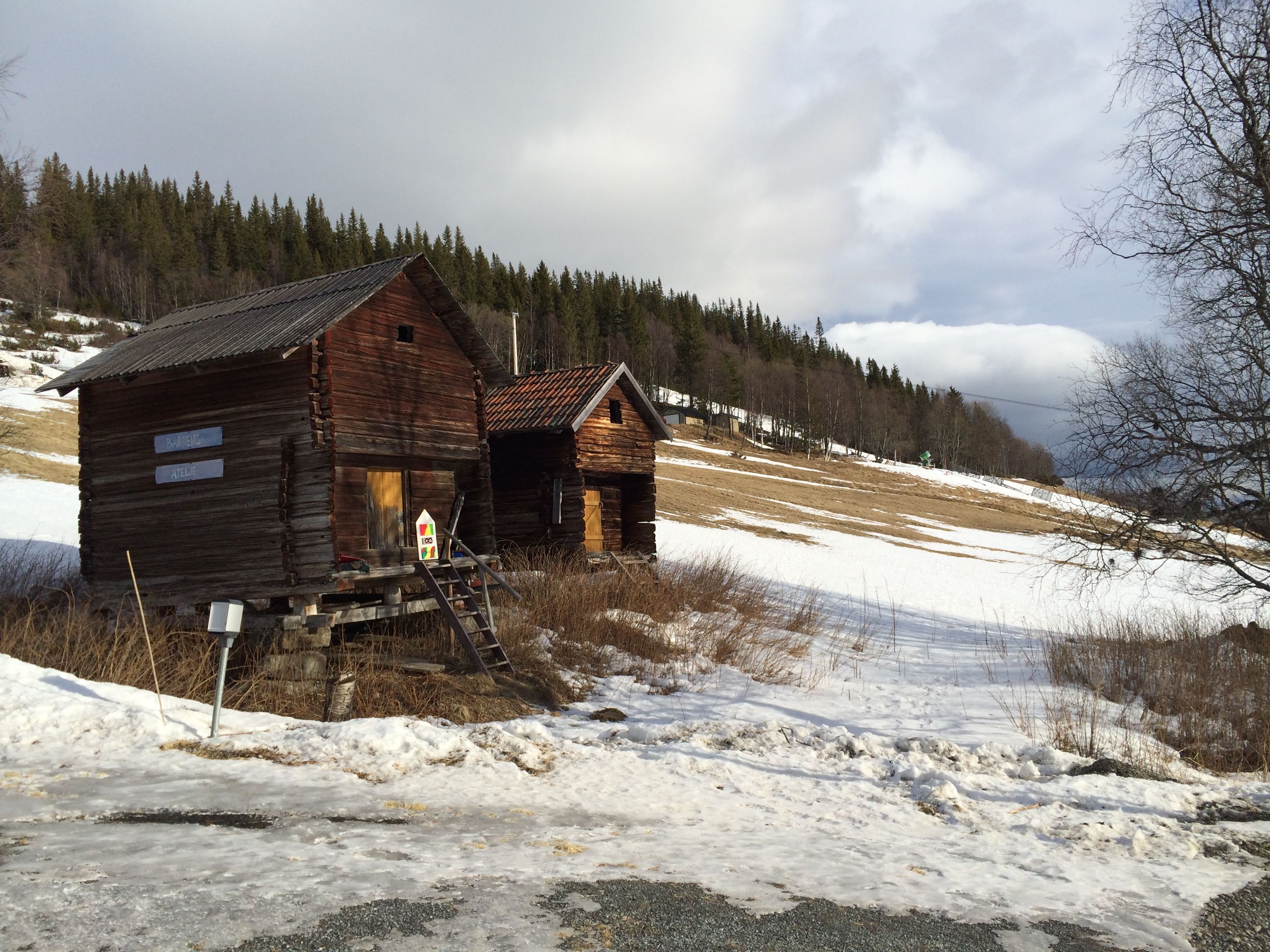
February in the Swedish mountains: where is the snow ? Global warming is a contributing factor to grape growing in Sweden.

SJ. How was your last harvest?

CW. Last autumn we had a very good year in terms of weather and we had our first proper harvest. Unfortunately, bees and wasps were a big problem and we lost a lot of our crop. We made 400 litres of wine  from the vintage. It is going to be a big test as far as the quality is concerned.

SJ. The cold weather comes in quite quickly in the autumn. Do you have to harvest early?

CW. As early as possible but the berries carry on ripening throughout October, so we harvest to the end of the month. 

SJ. Would you be able to make ice wine here ?

CW. The weather is not suitable in Bjäre for ice wine.

SJ. Do grapes mature sufficiently here for the production of quality wine?

CW. Yes, they do. Though chaptalisation (the addition of sugar) might be required during the winemaking process.

SJ. Are you going to expand your vineyard?

CW. No, I do not intend to expand. When I started out I had not foreseen how labor intensive, time consuming and costly grape growing and winemaking is!

SJ. Do you believe that Sweden has a future in the production of quality wine?

CW. Definitely. I feel that Bjäre is very similar to Germany and that we are following on the heels of the UK.


Ref.
Robinson, J., Harding, J. and Vouillamoz, J. (2012) Wine Grapes. London: Allen Lane-Penguin Books

Scandinavian food on the cutting edge – Oaxen

Last week, life could hardly have got any better: I dined out on consecutive nights in two of Stockholm’s top restaurants. Scandinavians certainly have more than one string to their bow. If they are the undisputed masters of design, they also excel in the art of cooking. The outcome as a diner is that you not only get to eat fantastic food but it is also beautifully presented and you enjoy it in a designer setting. Every item, from the cutlery to the wall panelling has been carefully selected. At present, nordic cuisine seems to be leading the world and has tapped into prevailing concerns and taste: Scandinavian chefs are working with seasonal and organic local produce, and are coming up with dishes of the utmost creativity and quality. Unexpected subtle flavours are combined, yet the final blend maintains a strong nordic identity. It is terroir at its best.

On Thursday evening I made my way through the snow over to Djurgården, to the edge of the island opposite the shipyards of Beckholmen and entered into the warmth of Oaxen Krog. The idea was to test a signature dish of one of the restaurant’s chefs, Emma Erlandsson, who reached the finals of Sweden’s most prestigious competition, Året’s kock, Chef of the Year. On February 5, Emma will be competing for the title against seven other finalists. “Practice makes perfect” so that is how I found myself sharing a table with seven other diners – six of them total strangers. Our meal was to feature appetisers, a starter and dessert from Oaxen’s menu, and Emma’s dish as the main course.

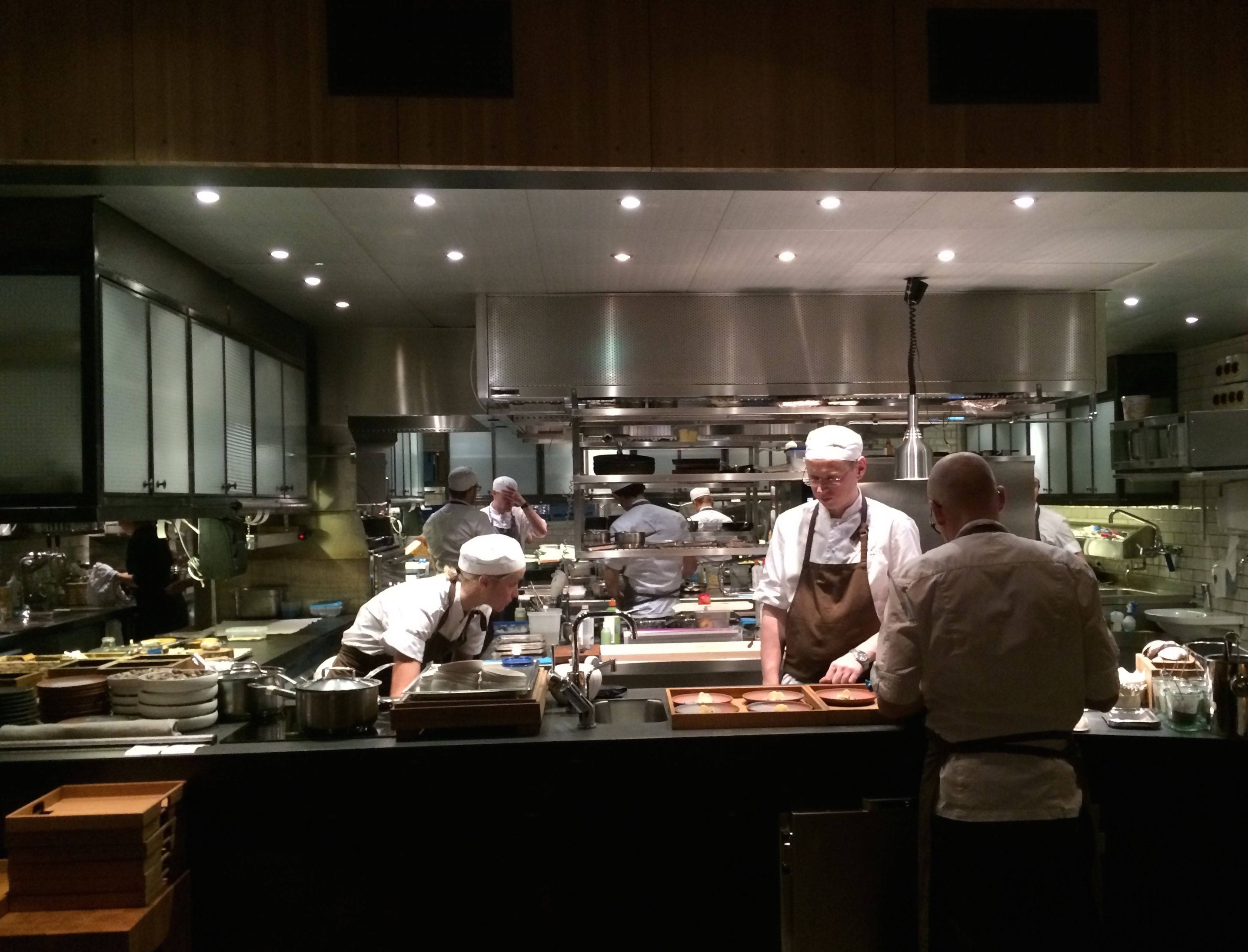
We sat at a table overlooking the modernistic stainless steel kitchen where staff effortlessly and in a relaxed fashion prepared our meal and that of the other guests at the krog. Amazingly not a clatter of a saucepan lid, or clang of kitchen equipment, or utterance, for that matter, was heard during the entire meal.

The kitchen at Oaxen

Oaxen – The kitchen

As we made the acquaintance of our fellow diners we were served a glass of Philippe Pacalet’s white Bourgogne Aligoté 2012 along with an array of small appetizers or tilltugg. The dishes were all different in character, varying from delicate to rustic and wholesome, yet all signalled their origin and connection to nature.

Mushroom crips with Gotland truffle and pumpkin cream - Oaxen

Mushroom crisps with Gotland truffle and pumpkin cream – Oaxen

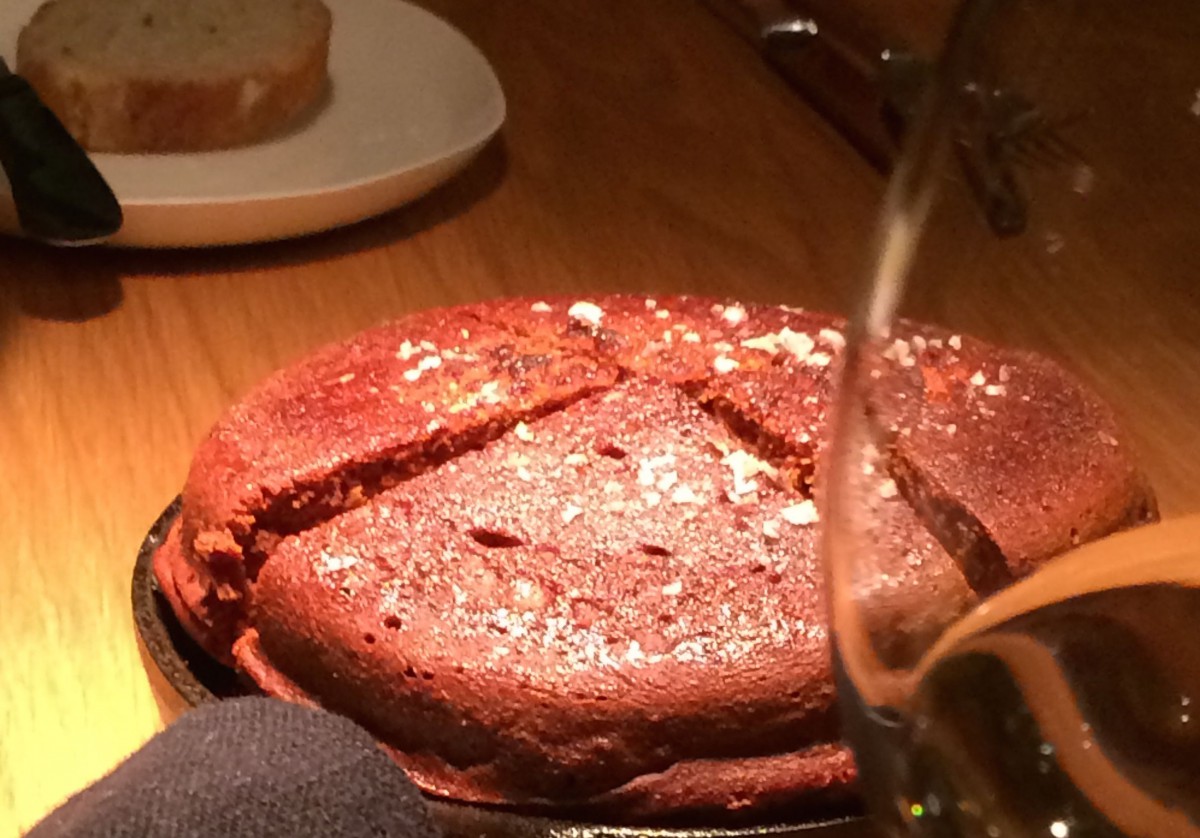
Warm rye bread baked with Pilsner

Oven-baked rye bread with Pilsner – Oaxen

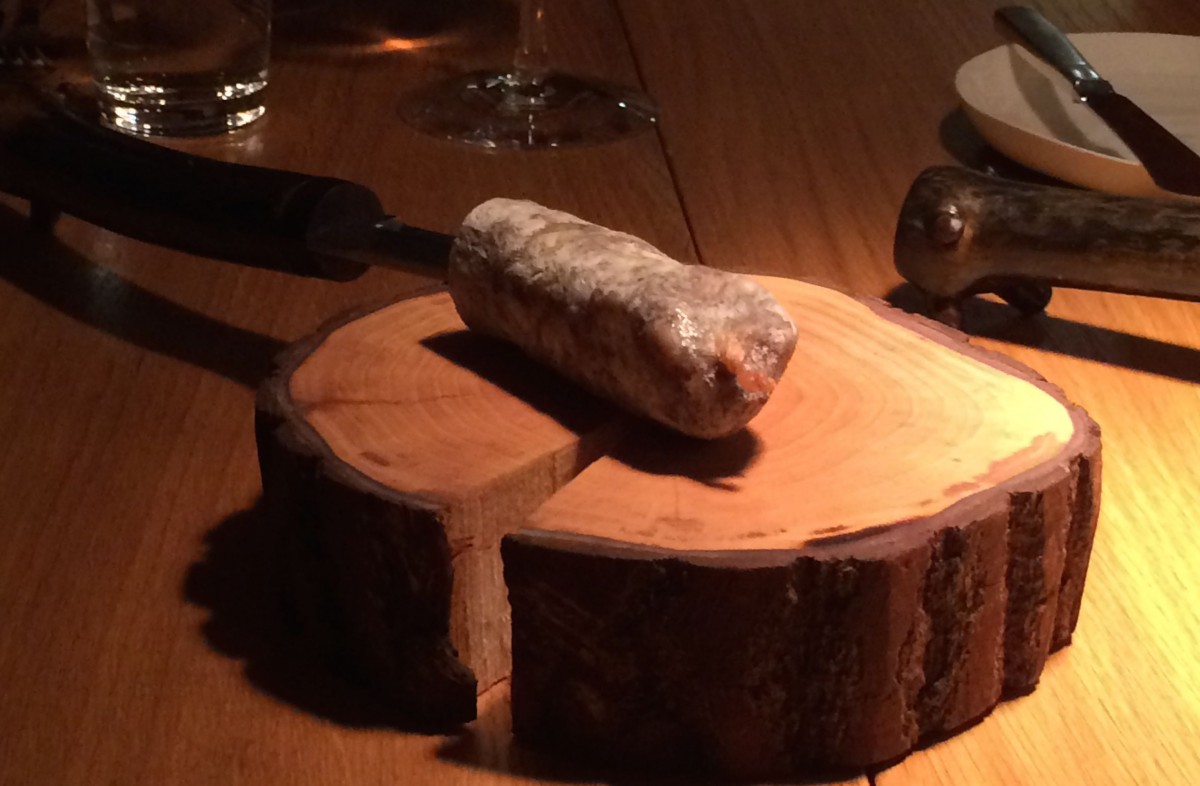
Saucisson - Oaxen

Locally produced saucisson – Oaxen

Bourgogne Aligoté 2012 from Philippe Pacalet

Bourgogne Aligoté 2012 from Philippe Pacalet – Oaxen

The pure crystalline-like Aligoté from winemaker Philippe Pacalet – renowned for using no SO2 during vinification and ageing – matched our earthy and fragrant starter, a scallop cooked in dill with kale, fennel and roasted almonds. The restrained aromatics and softness of the wine was in line with the sweet flesh of the seafood and allowed the gentle flavours of the greens to shine through.

Scallops and kale at Oaxen

Dill cooked scallop with kale, fennel and roasted almonds – Oaxen

Our plates were swiftly removed, new glasses appeared on the table, the red wine was served and we all sat up a little straighter in our seats. The much anticipated moment had finally arrived. The main course, Emma Erlandsson’s creation, was laid in front of us. Emma herself came to the table and delicately spooned the sauce onto our plates whilst possibly checking a last time for any shortcoming. Each dish was beautifully presented and complex in taste, reminiscent of the principles of washoku  和食 (traditional japanese cuisine): harmony and nutritional balance are achieved through five principles. Every meal should include five colors go shiki (red, yellow, green, black/brown and white) and five tastes go mi (salty, sour, sweet, bitter and spicy). The food should be prepared in five different ways go ho (simmering, steaming…) and appeal to the five senses go kan (sight, sound, smell, taste and touch – texture in the case of food). The final set of principles are the five outlooks go kan mon, grounded in Buddhism and pertaining to how we partake spiritually in the meal. Clearly, such an experience with food does carry a spiritual dimension and is a celebration of the produce that mother earth gives us, of the workers that cultivate it and of the chefs that prepare it in such a way that our enjoyment of food transcends to intense appreciation of life.

Emma serving her dish at Oaxen

Emma serving out the sauce on her dish at Oaxen

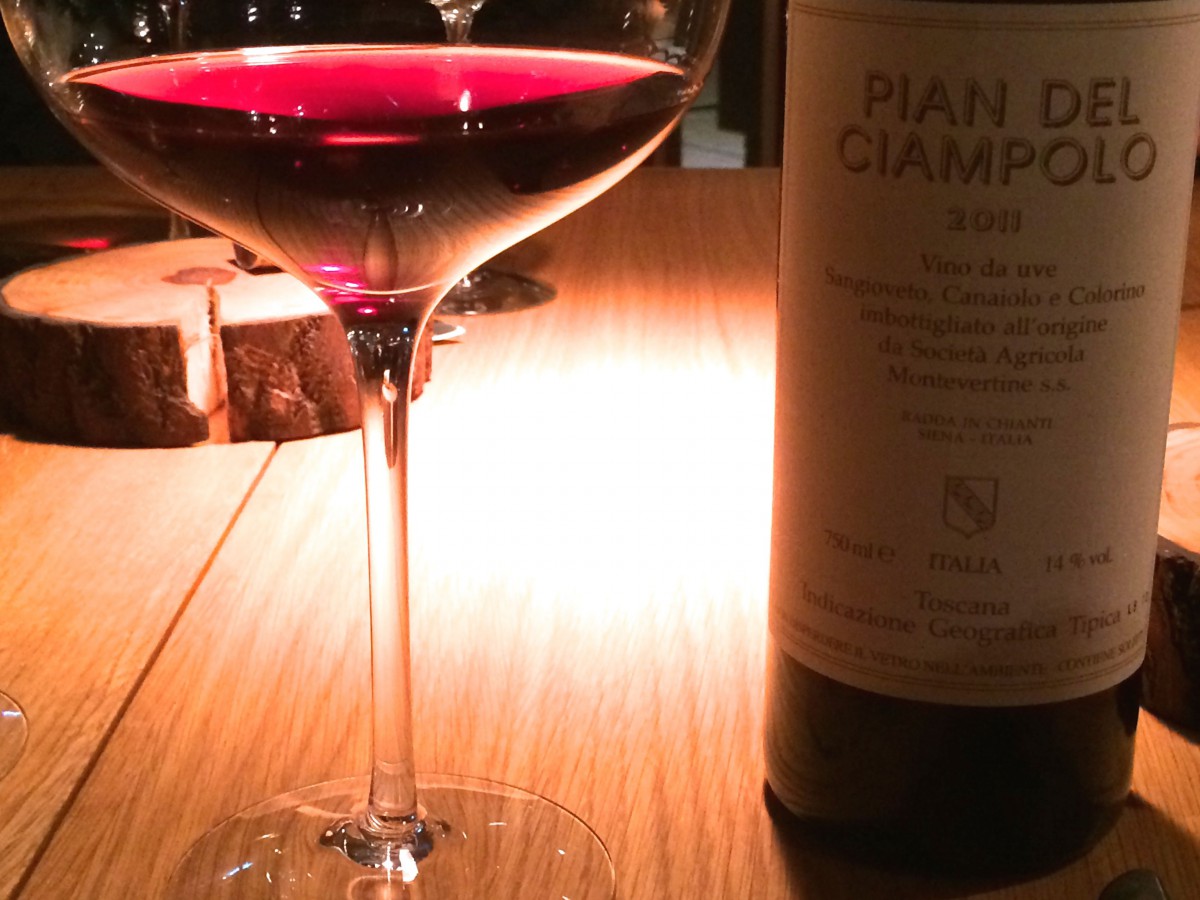
The red wine selected for the main course was, as with the white wine, a good match. Pian del Ciampolo, from Radda in Chianti in the centre of the Chianti Classico Zone is made from classic Chianti grape varieties, i.e. Sangiovese (or Sangioveto as stated on the bottle which is a synonym thereof), Canaiolo and Colorino. Incidentally, the soft and perfumed Canaiolo, now a permitted grape variety in the Chianti DOCG appellation, used to be the main grape variety in Chianti wine until the end of the 19th century when it was superseded by Sangiovese. Pian del Ciampolo, however, is not made in the style of a traditional Chianti and has indeed been bottled under the IGT appellation (Indicazione Geografica Tipica). Red sapphire-like in appearance, with notes of cherries, red berries, flowers and liquorice, it has a youthful, light, fresh and pure texture and it did not overwhelm Emma’s dish.

Pian del Ciampolo 2011

Pian del Ciampolo 2011, Soc. Agricola Montevertine, IGT Toscana – Oaxen

After submitting our feedback on the dish that Emma is entering for competition, we moved onto the next course, a stunning dessert from Oaxen’s menu. Sour cream ice cream with salted meringue, frozen lavender chocolate mousse and burnt Djurgård honey. Befittingly, the wine that accompanied the dessert was a refreshing ice wine, a sweet wine made from the juice of frozen grapes that are pressed whilst frozen. The wine in question was a Wehlener Klosterberg 2007, Mosel Riesling Eiswein from the producer Markus Molitor.

Dessert - Oaxen

Sour cream ice cream with salted meringue, frozen lavender chocolate mousse and burnt Djurgård honey – Oaxen

And thus after a warming cup of coffee, this snowy evening where eight strangers shared a meal came to an end. We shall return to Oaxen, soon, but in the meantime we wish Emma the best of luck for Årets Kock 2015.

Oaxen Krog & Slip
Beckholmsvägen 26
115 21 Stockholm
Tel. +46 8 551 531 05

IMG_2128

Stockholm – Eriks Bakficka

Trettondedag Jul (epiphany) was celebrated last Tuesday and the festive season is now officially over. Quite a few tired-looking Christmas trees are still on display, along with some advent lights, and this week-end many Trettondedag concerts have been taking place. However, as of now, it is in fact back to business. The good thing about this is that the restaurants that had been closed over the holidays are finally opening up again…

Just behind Strandvägen, up from the water’s edge in the district of Östermalm, Eriks Bakficka has everything you would want your local restaurant to have. Not too big (it seats 90 guests in different dining areas), it is cosy and its atmosphere is relaxed and friendly. The service is topnotch and the food is homely with traditional Swedish dishes as well as modern cuisine. The à la carte menu changes every couple of months or so whilst classic Swedish dishes are a staple offering. There is also a plat du jour on week days and a weekly special. The wine list has a good selection of wine by the glass and by the bottle with preference given to France and the Old World.

Eriks Bakficka – Östermalm
Fredrikshovsgatan 4, 115 23 Stockholm
Phone: +46 8 660 15 99
http://www.eriks.se

Eriks Bakficka - lobster entrée

Lobster with terrine of pickled yellow beets, winter salad and smoked lobster mayonnaise at Eriks Bakficka

Eriks Bakficka - Seared pikeperch

Seared pikeperch with roasted cauliflower purée, fennel and browned hazelnut butter at Eriks Bakficka

Menu for 2

1 x Jerusalem artichoke soup with grilled bacon (SEK 125.-)
1 x Toast Skagen (SEK 135.-)
1 x Venison loin with black trumpet mushrooms and Brussel sprouts (SEK 285.-)
1 x Seared pikeperch with roasted cauliflower purée, fennel and browned hazelnut butter (SEK 260.-)
2 x ice cream and sorbet (2 x SEK 105.-)

2 x Champagne Dieboldt-Vallois, NV, Selected cuvée, Erik Lallerstedt (2 x SEK 135.-)
1 x Jérôme Gueneau, Domaine des Grandes Perrières, Sancerre, 2013 (SEK 120.-)
1 x Bodegas Abanico, Ribera del Duero, Cathar Roble, 2011 (SEK 125.-)
Water
Coffee

Eriks Bakficka

Stockholm – Lights and mulled wine

Up here in the North the cold and darkness have firmly set in. The days now start in the dark and by 2pm the light is beginning to fade. Thick coats and gloves are a necessity. To counter this gloominess the Swedes have lamps on all their window ledges to softly brighten up their houses. In Advent the atmosphere is especially cosy with candles and illuminated red or white paper stars hanging at the windows, fires roaring in wood stoves and much drinking of mulled wine, here called glögg (from glödga “to heat, to mull”).

Time for glögg

Mulled wine is a tradition that goes back to the Middle Ages. Spices and heat enhance the warming effect of alcohol and improve a poor wine’s drinkability. Red wine is usually used for mulled wine and the traditional spices are cinnamon and cloves. Mulled wine – Glühwein in German and vin chaud in French – is enjoyed during the Christmas and New Year festivities but also whenever the weather calls for a hot, sweet, alcoholic beverage. In the mountains, on the slopes, it is the perfect drink to thaw out frozen fingers and toes, and to relax with. It is equally pleasant to drink during the winter in a town café or bistrot as an alternative to tea. In cafés, in France and Switzerland, vin chaud tends to be hot wine (watered down) served with a sachet of sugar and a tea bag containing spices. Mulled wine is usually prepared in the home. Recipes vary but most will contain any of the following: citrus fruit (chunks of orange, orange or lemon peel), cloves, star anise, cinnamon, cloves, pepper, vanilla, nutmeg, cardamon, ginger. (See below for some mulled wine recipes).

In Sweden, the tradition for drinking mulled wine is generally limited to Advent and so stops at Christmas. If some prepare their own glögg at home, many buy ready-made ones direct from the shop. According to a recipe from the 19th century traditional Swedish glögg is made from ordinary red wine and is seasoned with mace, cinnamon and cloves. Commercial glögg, however, comes in all sorts of different colours, sweetness and alcohol content. The latter varies from none at all, alcohol free, essentially spicy fruit juice, to low alcohol, to 10% for regular glögg (vinglögg) and around 15% for stronger glögg (starkvinsglögg). Some are made more alcoholic by the addition of spirits. The appearance ranges from pale straw to golden toffee and various shades of plum red depending on whether white wine, red wine, cider or fruit juice is used as the base. The different levels of sweetness and flavourings cater for most sugar fiends. On the store shelf traditional glögg lies next to bottles that have had rum or whisky added to them, and next to more exotically flavoured ones such as chocolate and vanilla, mint and chocolate, chilli and chocolate, or figs and port wine.

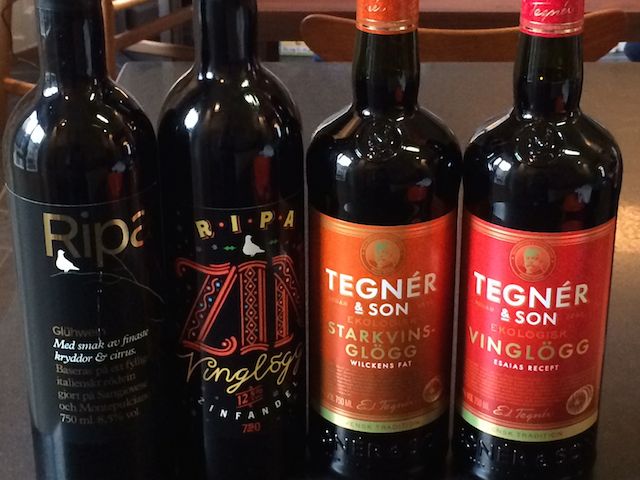
I caught up with Sören Sörensen, master blender at Galatea Spirits AB, to get some insider information on the mulled wine market. With a turnover in 2011 of 700 mio SEK, Galatea is a major importer of beer, wine, cider and spirits in Sweden and the biggest importer of beer in Scandinavia. Its other activities include distribution and production. Glögg is a drink Galatea make themselves under their own Swedish brands Ripa and Tegnér & Son. Whilst Ripa caters for a younger, more adventurous consumer, Tegnér & Son produces traditional beverages including a brandy which was awarded a silver medal by the IWSC in 2012.

Tegnér & Son and Ripa glögg

The jovial Swede greeted me in his offices with a member of the Tegnér family.

SJ. Why do you think that in Sweden it is so popular to buy ready-made glögg rather than make it yourself ?

Sören Sörensen. Possibly because Sweden as a whole has come to wine fairly recently and is not a wine producing country. There is, however, an old tradition here of drinking glögg. We have pictures in our archives dating from the end of the 19th-early 20th century of the wine cellars belonging to the wine merchants Tegnér & Wilcken. On one of the photos you can see a big wooden barrel with “Glögg” in white lettering.

SJ. Is glögg a Christmas tradition only ?


S. Sörensen. Glögg is drunk mainly in the build-up to Christmas with most of the sales taking place during the last 2 weeks of December. We would of course like to see the season extend but shelf space is only available at Systembolaget for glögg from the 1st of November until the end of January.

SJ. Is glögg only drunk in Sweden ?

S. Sörensen. We make it for the Swedes and also export to Finland.

SJ. The Swedish population is not huge (approx. 9.56 mio), the glögg season is very short, how many bottles are actually sold each year ?

S. Sörensen. Approximately 3.5 – 4 mio litres of alcoholic glögg, which is 5 mio bottles representing a value of roughly 350 mio SEK including tax.

SJ. Your brands are up against quite a number of competitors including Blossa, Dufvenkrooks, Saturnus, Morberg and Goder Aftonglögg to name a few.

S. Sörensen. The biggest competitor is Blossa, with 75% of market share. The remaining 25% is split between all the other glögg brands.

SJ. Blossa has a strong appeal, with a wide choice of glöggs. It also launches a new flavour and an attractive new bottle design every year. How are the glöggs that you are producing matching up to your competitors ?

S. Sörensen. We are focusing on producing quality products. We make sure that all the wine that is used for our glögg is of high quality and that it comes from reputable producers. Furthermore, all of our glögg is certified organic. Today, this is a strong selling point. We work with classic grape varieties, such as Zinfandel/Primitivo or Sangiovese. These varieties are well recognized and enjoyed in Sweden. We do not use colouring agents and we keep the sugar content 25% lower than our competitors do (at 175 g per litre for Tegnér & Son and Ripa Zin glögg). We also price our products a fraction below our main competitors.

SJ. You currently have 3 glöggs on the shelves at Systembolaget: Tegnér & Son Vinglögg, Tegnér & Son Starkvinsglögg and Ripa Zin. These brands are fairly recent, how did these glöggs come about ?

S. Sörensen. I have always prepared my own glögg at home, in a dryer German style. In 2011 I devised 8 different glögg blends for Galatea. The samples were submitted to Systembolaget and they accepted not 2 or 3 but all 8 of them! The blends were then made up commercially, bottled and launched in time for the festive season. Our glöggs have proven to be popular and in 2013 our sales were so good that our Tegnér & Son Vinglögg and Tegnér & Son Starkvinsglögg qualified for inclusion in this year’s range at Systembolaget.

SJ. So what is next ?

S. Sörensen. Our Tegnér & Son traditional glöggs will always make up 2 thirds of our glögg sales. This leaves me with the freedom to come up with some interesting and fun flavours for our Ripa brand!

Sören Sörensen already has plenty of ideas for blends involving traditional berries. I will say no more… I look forward to winter 2015.


A few recipes for mulled wine:

http://www.provins-club.ch/fr/newsletter/detail/la-recette-du-vin-chaud-du-valais-aoc-0-5675

http://www.elle.fr/Elle-a-Table/Recettes-de-cuisine/Vin-chaud-a-la-cannelle-547834

https://www.systembolaget.se/MatDryck/Recept/Drinkar/Kryddiga/Gluhwein/

http://www.decanter.com/specials/587785/video-how-to-make-the-perfect-christmas-mulled-wine

http://www.waitrose.com/home/recipes/recipe_directory/m/mulled_wine.html

The close of the Indian summer

The weather was breaking as were the dynamics of the vintage. The intensity of the work and the intimacy of the relationships amongst the team members was soon to dissipate and morph into aloofness. Many of the harvesters were planning their next move, others were waiting to resume a more viable everyday life. Colds were flying about the winery.

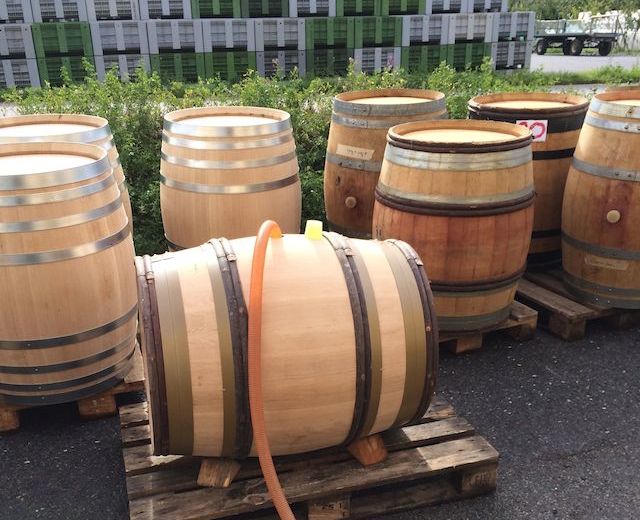
Meanwhile many of the wines were nearing the end of fermentation and preparations were being made for their transfer into new vessels. The used empty oak barriques were taken out of storage and wheeled outside in front of the winery. There, they were filled with water, emptied, steam cleaned and rinsed out, ready to receive the new wine. Water from the barriques was tasted to make sure that the wood was not imparting any unpleasant flavours and to correctly match the barrels to different wines. New barriques were also prepared and selected according to cooperage and toasting.

Preparing the barrels


Leo, the intern from Alsace, transferring wine into barrels

Leo, the intern from Alsace, transferring wine into barrels


Chai à barriques

Chai à barriques (wine cellar)


In the winery the whites were progressing nicely. Fermentations this year started off particularly quickly. Vats big and small, of different shapes and materials, were scattered on the floor space, accommodating the various grape varieties: Fendant, Petite Arvine, Roussanne, Ermitage, Completer, Païen, Humagne Blanche etc… The newly pressed white juices were left in tanks to settle. Thanks to gravity and cooler overnight temperatures, unwanted particles drop naturally to the bottom of the container. A day or so later the juice is racked, i.e. the clear juice is separated out by being transferred to another tank leaving the deposit behind. Racking is also carried out after fermentation to separate wine from the lees.


In spite of tiredness, spirits were rekindled for the harvest festival. Everyone gathered, fresh and clean, in festive clothes, to celebrate the 2014 vintage. Cups were kept full to accompany “raclette” (melted cheese) and potatoes, salads and marinaded barbecued meats served in the barn on a single long wooden table. Deserts – portuguese specialties – were prepared and brought along by some of the pickers. Marie-Thérèse Chappaz gave an emotional address to her team, thanking them for their hard work and reminding them that her wine would not be possible without them. Many bottles were enjoyed, from the Domaine and from other producers, though Marie-Thérèse’s regular workers refuse to drink any other wine than hers.

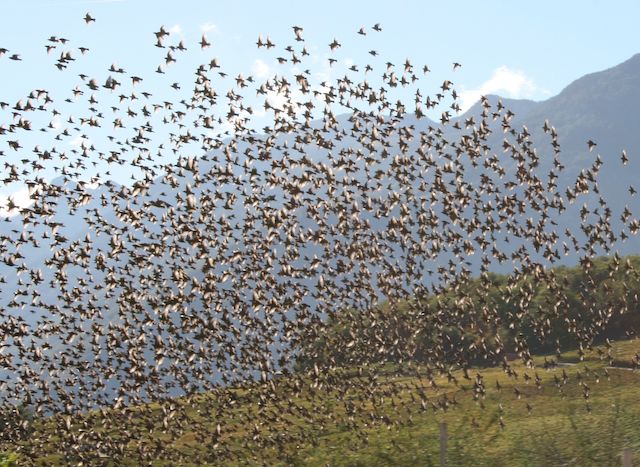
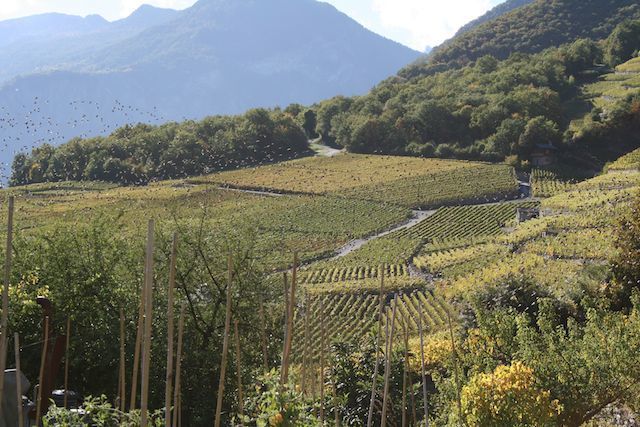
At the end of the week nature gave out its final burst of heat of the season and the weather was glorious. The interns left, and on the same day, starlings in the thousands migrated off down the Rhône valley in huge clouds.


IMG_7053

IMG_7054


Harvest on location at the domaine of Marie-Thérèse Chappaz, Domaine La Liaudisaz, Fully, Valais, Switzerland (www.chappaz.ch).


Harvest time at Domaine La Liaudisaz

The next couple of days rain loomed on the horizon and the impending question was whether to pick the grapes or give them extra ripening time. The ideal scenario is to leave the grapes on the vines for them to reach greater ripeness, to know precisely when the rain is going to fall and have the grapes picked and in the winery just before the clouds break. Any benefit from longer hang time would be dashed by unexpected rain as this would provoke loss of sugar and grey rot.

After much tergiversation Marie-Thérèse Chappaz decided to harvest her Syrah and Cornalin. The pickers duly worked on both Saturday and Sunday to beat the rain and thereby created a slight fluster in the village: a local resident came flapping into the vineyards in her dressing gown to complain about the noise, and at midday as the crates were loaded onto the back of the truck, a relatively young man standing on his frontdoor step asked us to lower our voices…

With most of the vineyards harvested, the casual workers returned to their native countries and the core work shifted to the winery. Secateurs and crates traded in for pumps and pipes.

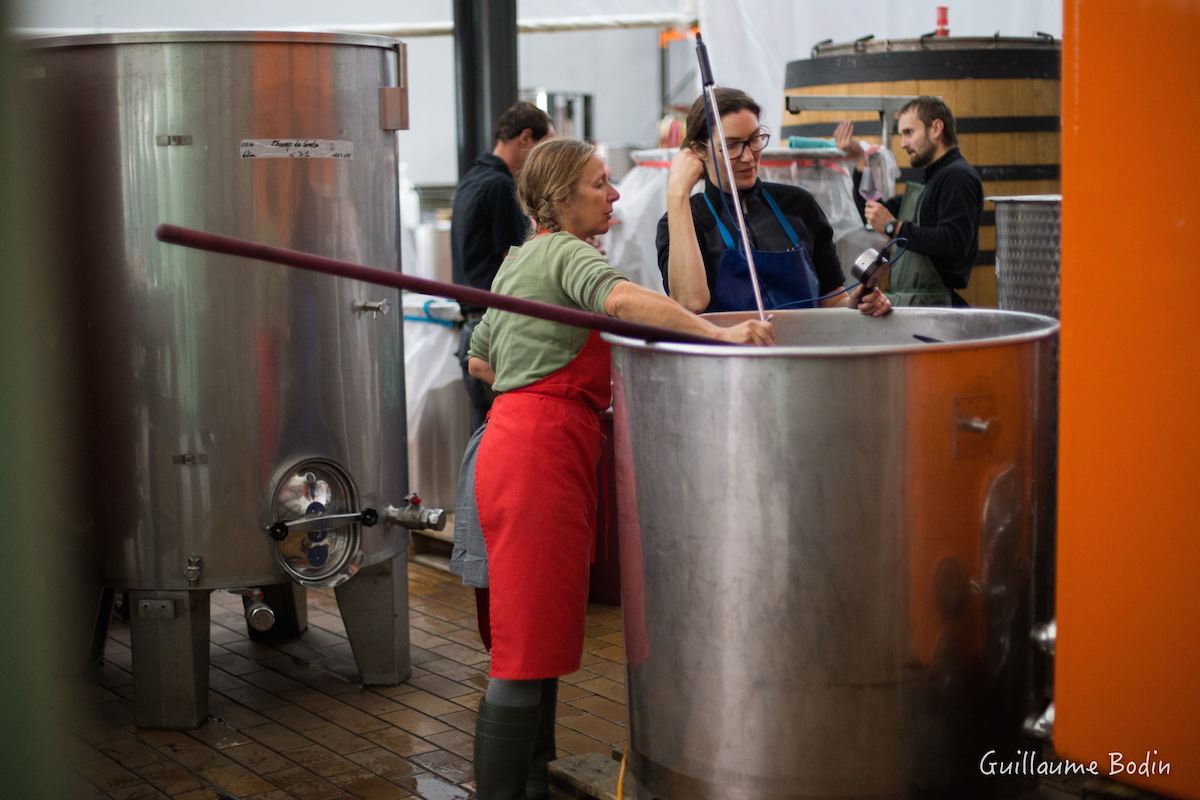
The daily routine is to monitor each tank. In the case of red wines, which here ferment in a variety of different tanks but mainly open top ones, a temperature reading is taken of the cap and the juice to check the progress of the fermentation. The density of the must is also measured daily. Grape must is more dense than alcohol, and during the fermentation process the density drops. Smelling and tasting the vat contents is also carried out daily. It allows the winemaker to detect any problem but more importantly it is the only way to gage how to manipulate the fermenting must: does the wine need more extraction, more contact with oxygen or more concentration…

Taking the temperature of the cap

Taking the temperature of the cap (MT Chappaz and Sarah)


Checking on the fermenting wine

Checking on the fermenting wine (Julien d’Abrigeon and MT Chappaz)


marie-therese-chappaz-27

MT Chappaz measuring the density

At the Domaine La Liaudisaz the wine making process is as non interventionist and as natural as can be. Fermentation starts spontaneously and there is no temperature control of the vats. Whenever possible juice is transferred from one container to another using gravity rather than a pump. Punch downs of the cap (“pigeage”) are carried out manually.

Many of these manipulations are of course feasible as the quantity of wine made is relatively small. Therein lies the beauty of small scale production: there is a greater direct human interaction with wine during the entire process, from grapes to bottle.

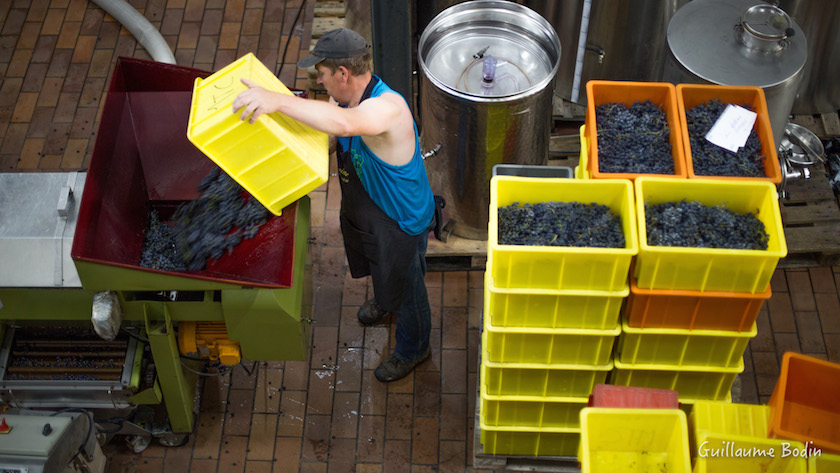
When hand harvested red grapes arrive in the winery, they are destalked and crushed. The juice and crushed berries are then housed together in vats to macerate and ferment. During the course of fermentation the vats are regularly homogenised: the crushed berries (skins, pips…) float on top of the juice forming a cap and have to be mixed in, or punched down (“pigeage” in French) once or many times during the day. This keeps the skins moist and allows the liquid to extract colour and flavour.

Grapes destemmed and crushed

Grapes destemmed and crushed


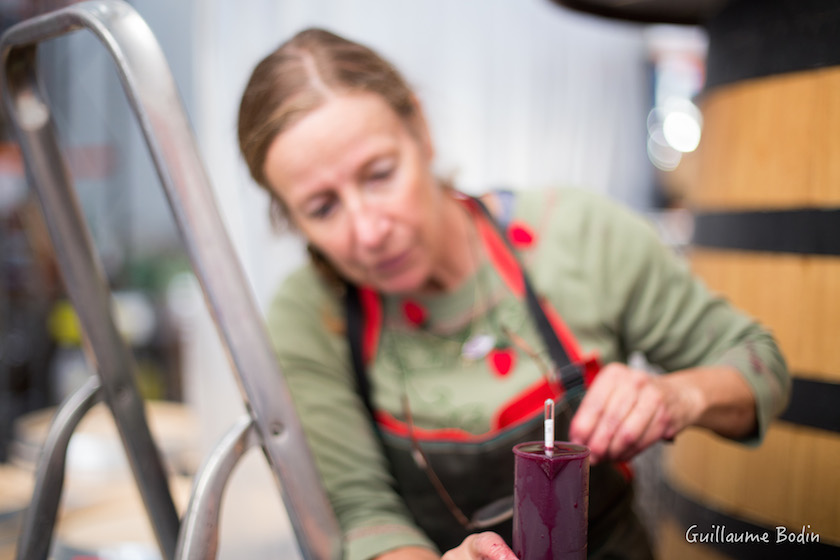
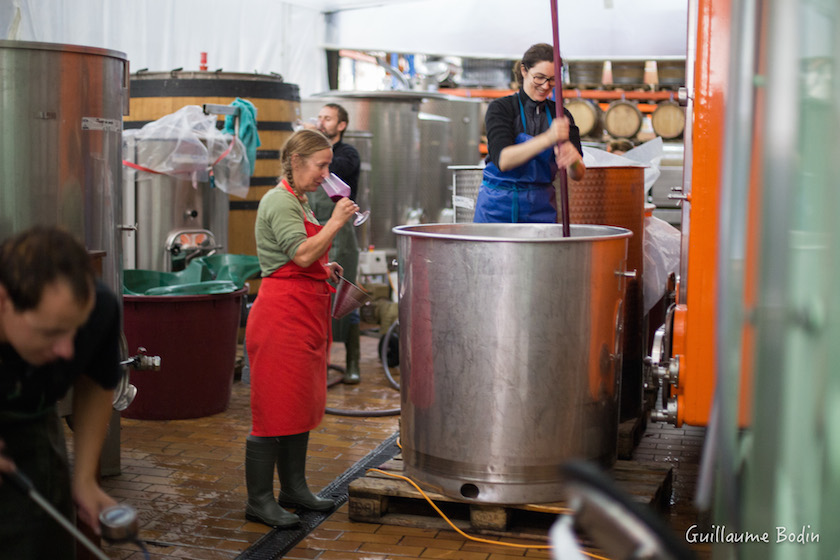
MT Chappaz tasting the fermenting wine and Sarah punching down

MT Chappaz tasting the fermenting wine and Sarah punching down


Aerating wine with a biodynamic flow form

Aerating wine with a biodynamic flow form


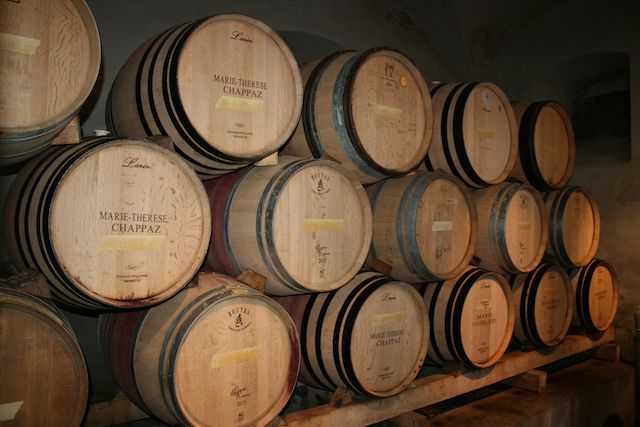
Once the red wines have finished fermenting, the liquid is transferred out of the tank into a temporary one. The skins, now sitting at the bottom of the tank are taken out to be pressed. The press wine is then added to the wine in the temporary vat. The combined wines are ready to start their maturation process in wooden barriques in a old stone cellar carved in the mountain rock.

The wine cellar

The wine cellar

Harvest on location at the domaine of Marie-Thérèse Chappaz, Domaine La Liaudisaz, Fully, Valais, Switzerland (www.chappaz.ch).

All the photos on this post (with the exception of the header) have been taken by the talented photographer Guillaume Bodin, who is also the author of a fantastic and award-winning film on biodynamic wine, “La Clef des Terroirs” (www.laclefdesterroirs.com).


Leaving town – Off on a harvest

On the 10th of October I packed my bags and set off for the Domaine La Liaudisaz, in Fully, in the Canton of Valais, in Switzerland. The Domaine is the property of Marie-Thérèse Chappaz, an amazingly charismatic and talented woman, a true “vigneronne” who not only makes wines but also tends to her vines. This she does with formidable determination. Believing that the quality of her wines cannot exceed that of her grapes, she nurtures her vineyards as she would her own flesh and blood. Indeed, herbal teas and bicarbonate of soda are a few of the preparations she administers to her vines, having embraced biodynamics some fifteen years ago.

If her wines are phenomenal, her vines radiate exuberance. In the summer, in particular, her vines stand out from those of others. Erect, lush, with vibrantly green and undamaged leaves the vines grow in symbiosis with their surroundings. Aromatic herbs such as thyme and hyssop mingle with wild strawberries, round-leaved pink geraniums, miniature pansies, poppies, grass and colourful flowers a plenty. Lizards, bees, grasshoppers, butterflies, flies and the occasional snake are seasonal residents.

This slideshow requires JavaScript.

I arrive with perfect timing just as the harvest pickers are having lunch. A hearty meal of venison stew and rice, bread and cheese served with the Domaine’s red and white wine has been laid on trestle tables amongst the terraced vineyards. The sun is shining brightly, the temperature is in the high 20s centigrade and the atmosphere is lively. A German photographer has joined in for the day to take pictures for an upcoming article featuring Marie-Thérèse Chappaz that will be published in the French nature magazine GEO (www.geo.fr).

After lunch the crates of grapes are collected and taken down the mountain to the winery by “chenillette” (tracked vehicle) and then, once a road has been reached, by car. The pickers are despatched in groups to the various vineyards dotted around the Rhône valley to resume the day’s harvesting.

As we drive down to the winery Marie-Thérèse explains to me the difficulties that they have had this vintage with the arrival in the area of a new pest: the Drosophila suzukii, an Asian vinegar fly. This tiny fly, yellowish-brown in colour, 2-3 mm long, is recognisable by its red eyes and by the single black spot that males have on the tip of each wing. This pest attacks soft fruit such asstrawberries, raspberries, blackberries as well as cherries, elderflower berries and grapes, to name a few. Its modus operandi is particularly destructive. Unlike the regular fruit or vinegar fly that is attracted to damaged or rotting fruit, the female Drosophila suzukii perforates healthy, ripening berries and lays her eggs inside. The larvae then hatch out and grow within the berry, leading to a rapid decomposition of the pulp. The small hole in the berry’s skin lets in bacteria and rot, which then attracts native fruit flies. For Marie-Thérèse, this year’s harvesting is taking longer than ever requiring a greater team of pickers working longer hours. Grapes have to be properly inspected and carefully sorted. All the affected berries and surrounding ones have to be removed from the bunch. The task is not made easier by the fact that the current weather conditions have induced the development of botrytis. If noble rot is desirable, grey rot and acid rot is not. Harvest pickers must therefore be able to make the distinction, keep what is good and get rid of the unwanted berries or bunches.

This is not so much a problem for the labourers who work regularly for Marie-Thérèse. Indeed her specialty is late-harvested and sweet white wines, which also requires selective picking. After our visit to the winery we head back up to a vineyard plot situated on a steep slope at an altitude of approximately 500 meters. The grape variety is Petite Arvine, a white variety native to the Valais. The variety is sensitive to rot and this year, as in 2011, the weather conditions have been such that the grapes have been attacked by noble rot. We work our way along the rows and using our fingers only, pick the botrytised berries off the bunches. Any berry that can still be further consumed by rot is left on the bunch to be harvested at a later date. These grapes which have literally been harvested a berry at a time will make Marie-Thérèse’s prized sweet “Grain par grain” Petite Arvine, Les Claives. The berries in their shrivelled condition will yield very little juice, but the sweet wine produced from it is of extreme concentration and complexity.

The small quantity of botrytised Petite Arvine berries is then pressed with a small wooden vertical press and the juice transferred into glass demi-johns where it will start fermenting.


Harvest on location at the domaine of Marie-Thérèse Chappaz, Domaine La Liaudisaz, Fully, Valais, Switzerland (www.chappaz.ch).