
The 16th was the 3rd Thursday of November, and as written in this week’s edition of Time Out magazine “a pretty big day in the wine world”. It is indeed Beaujolais Nouveau Day, the day when the new vintage of Beaujolais Nouveau wines hit the shelves of wine shops all over the world. This date has reached such fame that you do not have to be an oenophile nor a francophile to know about it and the catchy slogan announcing it: “Le Beaujolais Nouveau est arrivé”.
In many countries the arrival of Beaujolais Nouveau is a real day of merrymaking. An online search will quickly show you a list of events and bars that are celebrating. In London, plenty of restaurants are cooking up special dishes to pair with the light juicy Beaujolais wines. Some are also hosting winemakers at their tables. The cult restaurant Noble Rot is one them.

In Stockholm, Sweden’s capital and the area in the country where the most wine is consumed, Beaujolais Nouveau Day has caught on and is truly fêted. No sooner the wines get stacked in the monopoly’s temporary assortment that they are swiftly picked up by thirsty customers. Some wines, such as those of producer Jean Foillard, are eagerly awaited for and fly off the shelves. The French-Swedish Chamber of Commerce and the French Embassy host Beaujolais Nouveau wine tastings. Journalists are invited on morning television to present the wines and make suggestions for food pairings. As for wine bars, the third Thursday of November is an opportunity to add some cheer to the dark and cold winters and many therefore take part in the celebrations creating a party atmosphere throughout the city.
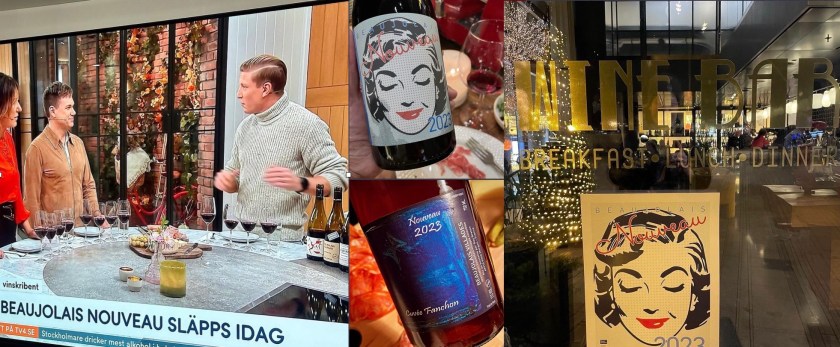
Having recently moved to the French speaking part of Switzerland I have been scouring the internet searching for some events or bars that are celebrating Beaujolais Nouveau wines in the area where I live. To my surprise, I couldn’t find much. So I drove down to Nyon, a small town but located in a region that has become very international, and dropped into bars and independent wine merchants. My request for Nouveau was met with offers of Bordeaux or Swiss wine until finally, I came across one Beaujolais Nouveau in the city centre’s supermarket.

The CCI France Suisse Chamber of Commerce had an event on the 16th of November but advertised it as “Beaujolais Pas Nouveau”. Photos from the previous year’s event showed that it was not Beaujolais Nouveau wines that were served but Beaujolais crus such as Morgon, Fleurie etc… Furthermore, the wines were from older vintages. Tellenne-Duguet Moulin-à-Vent 1966, Château Thivin Côte de Brouilly 1997 and Domaine Chignard Fleurie 2009 were three from the line-up. This is Beaujolais crashing Nouveau’s party. Has Beaujolais Nouveau lost its appeal in Switzerland or is it more of a big city crowd-pleaser?

Beaujolais Nouveau wines are made under the Beaujolais and Beaujolais Villages appellations that cover a vineyard of 8’000 ha. The grape variety used is the black Gamay Noir à Jus Blanc, a natural cross between Pinot Noir and Gouais Blanc. However, up to 15% of other grape varieties both black and white are permitted (Chardonnay, Aligoté, Melon, Pinot Gris, Pinot Noir, Gamay de Bouze and Gamay de Chaudenay – with the latter two varieties only allowed up to 10% of the total blend either alone or together). The winemaking process is quick, with extraction focused on flavours. The wines present very low tannins, flavours of “bonbons anglais” and juicy berries (strawberries, raspberries, cherries), a light body, some acidity and moderate alcohol. These features make them easy to drink wines, so-called “vins de soif”. They are also inexpensive. Bottled a few weeks after the grapes are picked and straight after fermentation, Beaujolais Nouveau wines are the first wines of the current harvest.
In 2022, Beaujolais, covering 12’520 ha all appellations included, produced 510’000 hectolitres of wine equivalent to 68 million bottles. Of the 68 m bottles, Beaujolais AOC produced 19.6 m, Beaujolais Villages AOC 16.8 m and the 10 Beaujolais Crus 31.6 m bottles. Nouveaux wines accounted for roughly 25% of total production with 124’000 hectolitres (16.5 m bottles). France kept 10 m bottles and the remaining 6.5 m bottles were exported to over 100 countries around the world. The biggest fans of Nouveau are the Japanese that imported 17’500 hl (2.3 m bottles), followed by the USA with 8’900 hl (1.2 m bottles), the UK (707’000 bottles), Canada (330’000 bottles), Belgium (200’000 bottles) and Germany (160’000 bottles).
For Beaujolais, the biggest export markets are the USA with 44’330 hl (5.9 m bottles), the UK 28’610hl (3.8 m bottles), Japan 19’814 hl (2.6 m bottles), Canada 18’768 hl (2.5 m bottles), Belgium 13’983 hl (1.9 m bottles) and the Netherlands 6’112 hl (815’000 bottles). Interestingly, the countries that import the most Nouveau also proportionally import the most Beaujolais. The exception being Japan that has a clear penchant solely for Nouveau, probably as the fruity, low tannin and light-bodied wine is well suited to its palate and cuisine.
Beaujolais offers a range of different styles of wine from the fresh, fruity, vibrant, glistening, shiny new-born bojo nouvo to the age-worthy crus, not to mention natural wines. Celebrating Beaujolais Nouveau on the 16th of November not only promotes that category of wine but also brings awareness to the other appellations of the region. The early sale of wine is also of economic importance, bridging the gap with Beaujolais wines of a different style that are released later or after a period of maturation.
The mid-November date for celebration happens to come shortly after festivals linked to the end of the agricultural year such as harvest festival and Saint-Martin (11 November), which is celebrated in countries such as Germany, the Netherlands, Belgium, Switzerland and Scandinavia (gåsamiddag). It is not surprising that quite a few of these countries are proponents of Beaujolais Nouveau. What better way is there to welcome the winter in than by celebrating in the company of friends with a glass of light, juicy, fruity wine and a plate of charcuterie and cheese?
 Nordic Wine Blog