Author: Sarah Jefford

Vintips – vecka 11

Äntligen. Ett löfte om våren även om den verkar ha försvunnit bland molnen. Isen är på väg bort. Det är dags att äta färsk, krispig, lätt mat och öppna några flaskor vitt vin. Dessa två viner matchade perfekt mitt vårhumör och finns nu på Systembolaget i små partier. Chardonnay är en mångfacetterad druva och båda vinerna passar med olika rätter som grönsaker, pasta, fisk, kyckling, fläsk, skinka, kanske med en gräddig sås. […]

Vintips – vecka 7

Det var nyligen Alsace och Bourgogne vindag i Stockholm och det inspirerade mig. Jag var inbjuden till middag med två tjejkompisar. Kvällens menu var smögen räkor, toast, ost och lite pannacotta till efterrätt. Jag hade tänkt köpa tre olika viner – som matchar olika plånböcker – för att prova vilken som passar bäst. Jag valde en mousserande och en Riesling från Alsace, och en vit Bourgogne. Det visade sig att vi tyckte att alla tre var bra med maten. […]

Alsace Pinot Noir ♥︎ A Red to Love

If you walk through the aisles of Sweden’s Systembolaget you won’t see any Pinot Noir from Alsace. If you look for wine on the monopoly’s website under France and Pinot Noir, you can only refine your search to the regions of Burgundy, Champagne and Languedoc-Roussillon. Alsace is not an option. The latter, of course might be attributable to the lack of subtlety of the website: after all Pinot Noir is produced in other regions of France, such as Sancerre. Be that as it may Alsace is not generally known for its red wines and this is not surprising. Of the 15’500 ha of vines under appellation, 1.15 mio hl of wine is produced of which 90% is white. In 1969 only 2.1 % of the total vineyard surface was allocated to Pinot Noir but over the years the percentage has crept up to just over 10% in 2014. Some of the Pinot Noir finds its way into Crémant d’Alsace, the region’s sparkling wine, and into rosé. The grape variety originated in Burgundy and was brought to Alsace by …

The Buddha in the Bottle

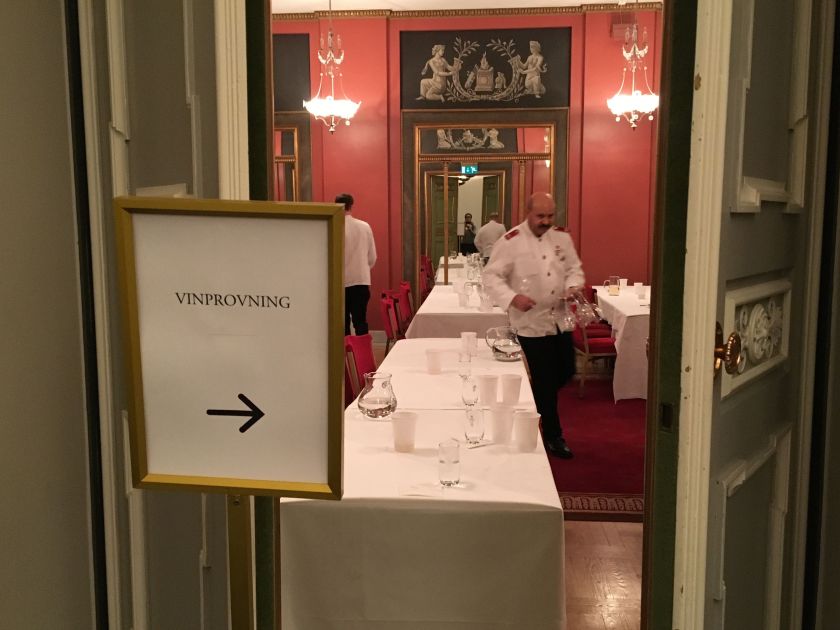
Hustle and bustle, laughter, elbows in ribs, not much room to manoeuvre, and lots of red wine, yes, you can guess, it was the Italian wine trade show. Were there lots of Italians present or was it the effect of Italian wine on Swedes? Either way, the atmosphere felt quite Mediterranean, which was very welcome on this icy cold day. And what better room for the show to take place in than the Grand Hotel’s Mirror room: gilded ceilings, gold panelled walls and vertiginously tall mirrors. Smiling benevolently from above, angelic faces adorned with bunches of grapes. White clad tables were lined along the wall like a row of dominoes, with not numbers but bottles matching up between tables. On every table red wine. Hardly a bottle of white in sight. What’s more, not red for the faint-hearted, but full-bodied, highly alcoholic and pulsing. Ripasso, Amarone della Valpolicella, Barolo, Barbaresco and Brunello di Montalcino. Every importer seemed to have a selection of these on his table. Bottles beckoned, promising to be better or more exciting than …

Munskänkarna – Don’t call them monks

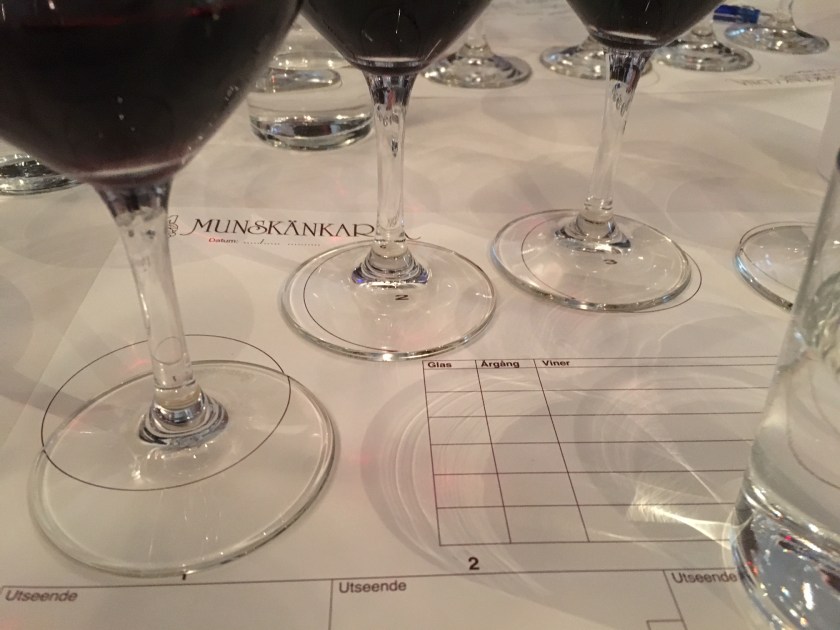
As I was reading through the week-end papers I came across a small discreet advert for Munskänkarna. Intrigued, I checked in my dictionary and discovered that the hard-to-pronounce-word means “the cup bearers”. I peruse the advert and after more leafing of my dictionary – or rather tapping on my phone’s dictionary app – I find out that Munskänkarna is a wine tasting club. Moreover, it claims to be the world’s biggest one. With more than 145 branches all over Sweden as well as abroad, the society offers regular wine tastings, seminars, wine education courses and also recommends wine travels. It publishes a newsletter, gives notice to members of new wines to be released by Systembolaget (the Swedish monopoly) and provides reviews of the wines as well. Constantly on the look-out for new opportunities to taste wine – trade fairs and tasting events in Stockholm are few and far between – I promptly fill in the application form and pay the reasonable yearly membership fee of 375 SEK (£28). A few days later an envelope drops …

A fine day for Australian wine

October 1st was World Sake Day, a day to celebrate sake and traditionally the start of a new sake brewing year in Japan. That event appears to have flown under the radar here in Sweden. On the 5th of October, however, it was Australia Day. Not that one was celebrating Australia up and down the country. It was, in fact, the name given by the nordic co-organisers of Wine Australia’s Annual Tasting in Stockholm. More than thirty exhibitors from different wine growing regions in Australia gathered in the Opera house in rooms overlooking a sunny Norrström and The Royal Palace. A quick glance at the list of exhibitors confirms that the usual suspects are taking part, i.e. Penfolds, D’Arenberg, Hardys, Jacob’s Creek and Lindeman’s to name a few. I make my way around the tables and try to get a feel for any new trend or new angle in this year’s trade show. The welcome note from Australia’s wine marketing body made a point of the country’s diversity, and the theme of the introductory masterclass (reserved …

Wines of Macedonia, the doppelgänger from the Balkans

This week was the trade tasting for wines from Macedonia. Not wines from Macedonia in Greece but from the Former Yugoslav Republic of Macedonia (FYROM) or Republic of Macedonia as it is officially called. If the country, confusingly, shares its name and a border with a Greek region, its wines could not be more different. In the Republic of Macedonia you will not encounter, as you do in northern Greece, Xinomavro, Negoska or Assyrtiko. Instead, the grape varieties are mainly a mix of classic French and local ones. These include Chardonnay, Sauvignon Blanc, Cabernet Sauvignon, Syrah and Merlot for the international grape varieties and Vranec, Temjanika, Zilavka, Kratoshija, Plavac Mali for the local varieties. Located in the Balkans, the country does not touch a sea. It is enclosed by Albania on the west, Kosovo and Serbia on the north, Bulgaria on the east and Greece on the south. Its capital is Skopje. The country is fairly mountainous and is cut across from north-west to south-east by the valley of the Vardar river. The Vardar river …

An escape to Greece – a narrative

It had been a long time since I last went to Greece but I still have vivid memories of summer holidays spent there. Happy childhood days clambering freely over the Acropolis, wandering through the ruins of Knossos, sitting on the throne of King Minos, eating juicy chunks of watermelon on a hot, dusty road. I returned later as a young adult, fresh from secondary studies in classics, and hiked around the south coast of Crete. Then, whenever my travelling companions and I stopped for a meal and refreshments, we were invariably offered Ouzo, Retsina or Metaxa. Food was more often than not basic and rather greasy. Communication was carried out in a mix of ancient and modern Greek. How things have changed. During this summer’s vacation I did not have a single bad meal and not once was I recommended retsina. Restaurants served up a selection of succulent traditional and innovative dishes made from fresh local produce. There never was any problem in shops or when ordering food as everyone spoke English. As far as alcoholic …

Wizardry in the kitchen at Gastrologik

The night was dark and frosty as we set out for our evening meal. A table had been booked and was waiting for us. Our hearts were beating a little fast as we were running late but also in anticipation of our meal. Not one of us had been there before. We had walked past many times, but the long white undulating and impersonal curtains stared back and revealed nothing. We arrive at the front door and peer through the window pane down the corridor. We glimpse some activity at the far end, dashes of white movement amongst glistening steel. A waiter comes to greet us at the entrance and accompanies us to our table. We make our way past the long wooden fronted workbench where chefs stand hunched over pots and saucepans.   We seat ourselves and as we are poured a thirst-quenching glass of the house champagne, 2007 vintage Deutz, we are quizzed as to whether we have dined here before. To the answer “no”, the waitress looks at us enigmatically and glides off to …

Go West Stockholm - Mark de Vere MW

Fair Maidens and Cowboys – Part 2

Austria conjures up Riesling and Grüner Veltliner but the wines Austrian wine producer Dorli Muhr presented us with were from the red varietals Syrah and Blaufränkisch. Her path to becoming a wine producer is an interesting one. Born in Carnuntum in Austria to parents who are farmers, she is an entrepreneur and set up her own PR business whilst still studying. Her field of expertise is the good things in life but most specifically food and wine. When she met her husband Dirk van der Niepoort of Douro fame they decided to produce wine together. But Dorli was very particular about what kind of wines she wanted to make. No jammy notes, the wines had to be fresh and elegant. Austria seemed to be the ideal place to produce Dorli’s style of wine. She thus left Portugal where she had been living and with Dirk she set up her winemaking venture where she was born, in Carnuntum. Carnuntum is today one of the eight wine regions in Niederösterreich (Lower Austria). During Roman times, Carnuntum was …