Latest Posts

Vintips – vecka 11

Äntligen. Ett löfte om våren även om den verkar ha försvunnit bland molnen. Isen är på väg bort. Det är dags att äta färsk, krispig, lätt mat och öppna några flaskor vitt vin.

Dessa två viner matchade perfekt mitt vårhumör och finns nu på Systembolaget i små partier. Chardonnay är en mångfacetterad druva och båda vinerna passar med olika rätter som grönsaker, pasta, fisk, kyckling, fläsk, skinka, kanske med en gräddig sås. […] Read More

Vintips – vecka 7

Det var nyligen Alsace och Bourgogne vindag i Stockholm och det inspirerade mig. Jag var inbjuden till middag med två tjejkompisar. Kvällens menu var smögen räkor, toast, ost och lite pannacotta till efterrätt. Jag hade tänkt köpa tre olika viner – som matchar olika plånböcker – för att prova vilken som passar bäst. Jag valde en mousserande och en Riesling från Alsace, och en vit Bourgogne. Det visade sig att vi tyckte att alla tre var bra med maten. […]

Read More

Alsace Pinot Noir ♥︎ A Red to Love

If you walk through the aisles of Sweden’s Systembolaget you won’t see any Pinot Noir from Alsace. If you look for wine on the monopoly’s website under France and Pinot Noir, you can only refine your search to the regions of Burgundy, Champagne and Languedoc-Roussillon. Alsace is not an option. The latter, of course might be attributable to the lack of subtlety of the website: after all Pinot Noir is produced in other regions of France, such as Sancerre.

Be that as it may Alsace is not generally known for its red wines and this is not surprising. Of the 15’500 ha of vines under appellation, 1.15 mio hl of wine is produced of which 90% is white. In 1969 only 2.1 % of the total vineyard surface was allocated to Pinot Noir but over the years the percentage has crept up to just over 10% in 2014. Some of the Pinot Noir finds its way into Crémant d’Alsace, the region’s sparkling wine, and into rosé.

The grape variety originated in Burgundy and was brought to Alsace by monks during the Middle Ages. At that time more red wine was drunk than white. No doubt red was a better match for the diet which included foods such as salted meats, salted fish and cabbage.

Alsace Pinot Noir has historically been a light wine both in colour and body. Today, however, some of the region’s winemakers are producing reds that have more depth of colour, more flavour and more texture. One of the first to pave the way in the production of such wines was the Domaine Paul Blanck, in the Kaysersberg Valley, a twenty minute drive from Colmar. Not far away, in Bergheim, just north-east of Ribeauvillé, Marcel Deiss is another winery which advocates more concentrated red wines.

The only permitted red grape variety under the Alsace Appellation (AOC), Pinot Noir is a tricky variety to work with. It has compact bunches of small, thin-skinned berries. It is sensitive to rot and its yields are irregular. Nevertheless, Alsace presents some very favourable growing conditions: it has a low rainfall and a long growing season. This translates as a reduced risk of rot and an increased possibility for berries to reach perfect maturation.

The latter two points are indeed key for producing quality red wines. In fact, there are four conditions that need to be met for making more concentrated Pinot Noir wines. Firstly, grapes have to be ripe –  and this includes pips which must no longer be green but brown. Secondly, the berries need to be in perfect health and free of rot. As well as giving juice a musty taste, grey rot destroys its colour. Thirdly, yields need to be kept low. In the past, yields have simply been too high. Optimal yields are around 30-35 hl/ha (hectolitres per hectare). There is a big drop in concentration in wine when yields increase to 50-60 hl/ha. Interestingly, for a red wine to qualify for either the Alsace AOC, the Alsace Communal AOC or the Alsace Lieu-dit AOC, the upper limit for yields 60 hl/ha. Thus, 30 to 35 hl/ha is well below the legal maximum. Finally, the fourth determining factor impacting the character of the wine is the soil type. Alsace has a complex geology and thirteen main soil types. The best soils for Pinot Noir wines are clay or marl with an iron content for depth of colour and complexity, and limestone for freshness.

Alsace_pinot_noir

Alsace Pinot Noir – many shades of crystalline ruby

Most winemakers in Alsace share an ecological approach to viticulture and are either sustainable, organic or biodynamic. As far as the vinification and maturation of Pinot Noir is concerned, there does not appear to be a general consensus. Some winemakers use whole clusters, some destem or part destem. Regarding maturation vessels, many different materials and sizes are used: stainless steel, new and old oak barriques, demi-muid and foudres. The length of maturation is also variable (between eight months and two years). The tradition in Alsace is to use bigger wooden oval-shaped containers known in French as “foudres” to maintain silky tannins and to avoid imparting too much wood flavour to the delicate Pinot Noir.

The “Wines of Alsace” trade event that took place last week in Stockholm kicked off with a seminar showcasing Pinot Noir. The seminar included a presentation and tasting of six Pinots Noirs from different producers. These wines beautifully displayed the essence of Alsatian Pinot Noir: wonderfully light in body yet focused, perfumed, fresh, earthy, mineral, dry, with silky tannins and aromas of red berries, cherries. And shining in the glass like a red ruby dropped in water. They are best served fairly cool, at around 12° Celsius and can accompany beef, duck and game.


Wines tasted

Charles Wantz, Pinot Noir 2012, Rouge d’Ottrott, AOC Alsace Ottrott
Tasting note: Medium intensity, burnt red colour. Leather, earth, dried herbs, dried strawberries on the nose followed by red fruit, delicate acidity and a light body on the palate. A wine to be enjoyed now. 

Ottrott is an area that has been famous for its red wines since the 11th century. It is here that the monks first arrived from Burgundy. Located close to Obernai, in the north of Alsace, Ottrott is a communal appellation with mainly sandy and sandstone soils. This type of soil tends to create wines with lower levels of acidity.

Domaine Pfister, Pinot Noir 2012, Rahn, AOC Alsace
Tasting note: Medium intensity, ruby red with a tinge of raspberry. Milky, smoky, wild strawberries and fresh on the nose. Red fruit, savouriness, fresh acidity, elegance, silky tannins and light juicy body. Dry finish with wafts of sweet dark fruit.

Domaine Pfister is located in the north of Alsace, in the village of Dahlenheim, twenty kilometres from Strasbourg. The Pinot Noir vines are rooted in loess and limestone soils, which accounts for the good acidity of the wine. The winemaker, Mélanie Pfister, has a special affinity with Pinot Noir. She completed her studies with work experience in the Côte d’Or in Burgundy. For her Rahn Pinot, Mélanie chose whole cluster fermentation, 10%-20% new French oak barrels and no filtration.

Domaine Boeckel, Pinot Noir 2013, Les Terres Rouges, AOC Alsace
Tasting note: Medium intensity of colour, purple ruby. Herby, minty, strawberry sweets and violets, good balance between acidity and silky tannins.

Here is an organic Pinot Noir made by a Domaine from Mittelbergheim, a village which has been classified as one of the most beautiful of France. Marl, clay and limestone soil, yields of 45 hl/ha and a maturation of 18 months in 10% new oak barrels. The marl/clay is responsible for the good tannin structure and good colour, whereas the limestone is responsible for the fresh acidity.

Domaine Albert Mann, Pinot Noir 2013, Les Saintes Claires, AOC Alsace
Tasting note: Medium intensity of colour, purply red. Red and dark fruit on the nose, some leather and spice, fresh, nicely concentrated. On the palate red and blue fruit come to the fore. Elegant blend of fruit, acidity and tannins. 

The domaine is situated in Wettolsheim, just south of Colmar, but Les Saintes Claires is made from a vineyard attached to an old monastery in Sigolsheim where the soil is pure limestone. Yields are kept low at 20 hl/ha. The wine spends seventeen months in barrels.

Domaine_Paul_Blanck_Alsace

Domaine Paul Blanck in the Kaysersberg Valley, Alsace

Domaine Paul Blanck, Pinot Noir 2010, “F”, AOC Alsace
Tasting note: Medium intensity of colour, ruby. Elegant nose, fresh juicy blue and red fruit with a touch of sweetness. On the palate attractive acidity and concentration, fresh strawberries, cherries, a light velvety body, silky tannins, a dry finish with a touch of 
sweet fruit on the length. 

The Domaine Paul Blanck was one of the first to think about the potential of certain “crus” for Pinot Noir. As a matter of fact, their Pinot Noir “F” is made from grapes grown on one of Alsace’s 51 Grand Cru sites. “F” stands for Furstentum. In Alsace, however, the Grand Cru designation can only be used for the four noble white varieties, i.e. Riesling, Gewürztraminer, Pinot Gris and Muscat. Hence the “F” on the bottle and the AOC Alsace classification. 2010 was a great vintage for Alsace.

Marcel Deiss, Pinot Noir 2011, Burlenberg, AOC Alsace
Tasting note: Medium intensity of colour, crushed mulberries. Elegant restrained fruit on the nose. Good acidity, noticeable tannins, white pepper, meatiness, red fruit, cherries, a little rough, but light in body. Needs some bottle ageing.

The Domaine Marcel Deiss, in Bergheim 3 km from Ribeauvillé, is well-known for its biodynamic wines. Mathieu Deiss, who is now working alongside his father Jean-Michel, explains during the seminar that Burlenberg is a “Lieu-dit” up a hill, on rocky limestone soil. The natural acidity in the wine is due to the elevation of the vineyard. Maturity is pushed to get a lot of tannins out of the grapes but as a result the wine needs time to evolve and to smooth out. The wine has not been filtered and use of sulphur dioxide is kept to a minimum. They work with low yields – at Burlenberg yields are 15-20 hl/ha – and in order to do so they plant vines at a high density. They believe that competition, and not green harvest, is the optimal way to reduce yields. According to Mathieu, Alsace on the whole is thinking along the same line. Burlenberg, in a bid to express terroir, is made from a field blend of Pinot Noir and a small proportion of a few other Pinot varieties including Pinot Gris and Pinot Blanc.


Having been seduced by the Pinots Noirs selected for the seminar, I went to meet some of their producers at the “Wines of Alsace” event to discover more of their range.

Mélanie_Pfister_Alsace

Mélanie Pfister, the lively and passionate winemaker at Domaine Pfister, Dahlenheim, Alsace

Mélanie Pfister is the winemaker at the family domaine, where she took over from her father eight years ago. Domaine Pfister in Dahlenheim in the north of Alsace has ten hectares of vines surrounding the family home. The commune is famous for its Grand Cru Engelberg, literally meaning the mountain of the angels. Wines from Engelberg have had a reputation of excellence for over a thousand years. Like many Alsatian winemakers, Domaine Pfister is committed to playing a caring and respectful role within its environment. It has been certified sustainable by Fair’n Green – a German association of which Georg Breuer and Leitz Weingut are also members. They cultivate all the main Alsatian grape varieties. Riesling is their most important one and occupies 25% of the vineyard area.

Their hallmark is wines that are fresh, pure, ripe and attractive.

Tasting impressions

  • Crémant d’Alsace, Brut, Blanc de Blanc – Made from a blend of white skinned grapes only, i.e. Chardonnay (50%) and Pinot Blanc, Pinot Auxerrois (50%), this Crémant awakens the senses with its lovely ripeness of fruit. Red fruit, stone fruit, tropical and toasty notes are carried on the palate by elegant bubbles and fine acidity. It has spent 29 months “sur lattes” (i.e. in contact with lees before disgorgement) which has given it nice yeasty notes and more complexity.
  • Pinot Blanc 2013 – Nice fullness on the palate, fresh, ripe stone fruit with a long length.
  • Riesling 2014, Tradition –  Light body, juicy acidity, warm peach, tasty finish.
  • Pinot Gris 2014, Tradition –  Made in the same style as her grandfather, the Pinot Gris Tradition is dry, elegant, pure, with fruity flavours of apples, ripe lemons, and a nice long finish.
  • Grand Cru Engelberg, Riesling 2012 – This wine is released later than those mentioned above. Wines made from Grands Crus take longer to develop. Concentrated nose, some kerosene, ripe limes, banana, mango. On the palate dry, fine acidity. A long length with lingering ripe fruit.


Philippe_Blanck_Alsace

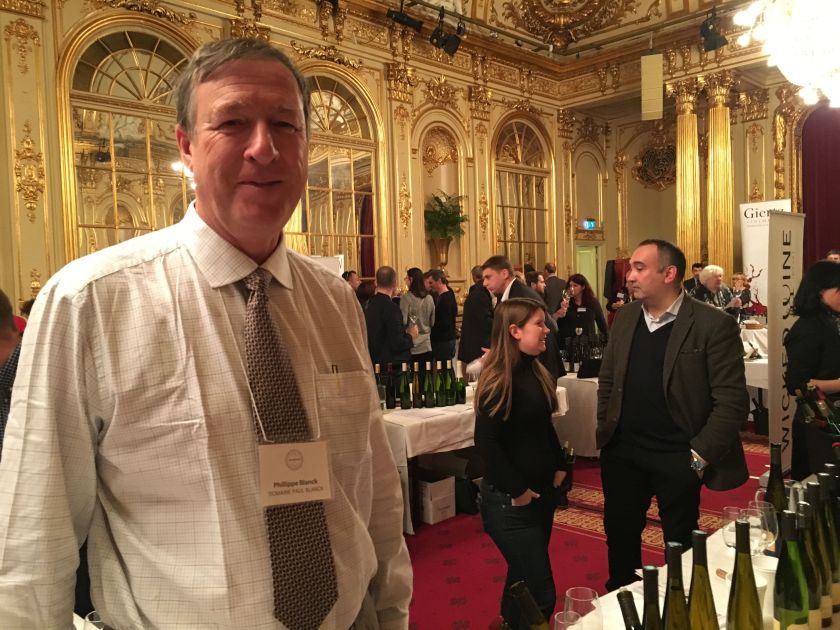
Philippe Blanck, from Domaine Paul Blanck, Kientzheim, Alsace

Practically opposite Mélanie Pfister’s table was Domaine Paul Blanck’s, and towering behind it the genial Philippe Blanck. I was all set to try out his wines made from the typical Alsatian grape varieties: his Pinot Gris Patergarten, his Gewürztraminer Altenbourg, his Auxerrois Vieilles Vignes, not forgetting his Grands Crus, Vendanges Tardives and Sélections de Grains Nobles.

Philippe, however, had an entirely different idea in store for me. He started by pouring me a glass of his Riesling de Terroir, i.e. made from the lieu-dit Rosenbourg, a plot with soils of marls over granit. The vintage was 2014, which produced wines characterized by their fruitiness.  The Blanck Riesling 2014 Rosenbourg was very fine, with digestible acidity, citrus fruit and a mouthfeel with presence.

Next we tasted a Wineck-Schlossberg Riesling 2012. Parameters are here different: lower yields in the vineyard (20 hl/ha), a Grand Cru with granitic soils, and the 2012 vintage which produced wines with quite a lot of acidity, as the year was cold and rainy, but nevertheless fruity. This wine was complex, elegant with fine acidity, ripe fruit, pears and almond.

Finally he served the Domaine Paul Blanck, Riesling 2011, Grand Cru Schlossberg. Schlossberg is the most famous Grand Cru appellation in Alsace. It was established in November 1975 and was the very first. It is located on the commune of Kientzheim, in the Haut-Rhin, not far from Colmar. Its soils are composed of granit. The 2011 vintage in Alsace was a warm one but this didn’t prevent wines from showing beautiful acidity. On the palate, this Riesling certainly displayed greater acidity than the previous wines tasted. Its texture was dense and taut, with a full body, citrus and limes, and a long finish tailing off with flavours of warm ripe peach.

Riesling and Riesling only. No other grape variety tasted.

Philippe’s idea was for me to experience the manifold expression of Riesling through different vintages, soils, and many other parameters; to tune into the fine details that can be picked up in a wine, if one takes the time to search for them, to fully experience the emotion of tasting wine.  I suppose the grape variety, in this case Riesling, can be compared to an instrument or a musician. Ultimately, they are the channel through which music goes. They bring music to life, making the musical experience possible. The music, as it is written, remains the same. Its expression will vary depending on who interprets it, on how the interpreter is feeling, on what his vision is, on the ambient temperature, on how the listener himself is feeling, etc… The same sort of experience and emotions take place with wine.

The tasting could have ended there but Philippe took all three Rieslings and decanted them. I can’t say I have ever decanted white wine before. He then got me to taste side by side the Riesling poured straight from the bottle and the same one decanted. Sure enough, the tasting experience was not identical. Decanting brings other elements to the fore. Would I even recognise the wines as being the same? The young 2014 Riesling displayed a slight metallic edge and citrus, yet when decanted it came across as riper, sweeter and with a plumper and more textured body.

Philippe went on to explain that the way you breathe when you sniff a wine also impacts what you get out of it. A short sniff – which is what one usually does – will not capture the same fragrances as if you take a long sniff filling out your ribs with air. I didn’t try that out on the spot but can see that he probably has a point. I think I will experiment quietly at home, hoping that I don’t hyperventilate before having had a sip of wine…

Alsace_wine_route

The Alsace Wine Route

(All photos by Sarah Jefford)

The Buddha in the Bottle

Hustle and bustle, laughter, elbows in ribs, not much room to manoeuvre, and lots of red wine, yes, you can guess, it was the Italian wine trade show. Were there lots of Italians present or was it the effect of Italian wine on Swedes? Either way, the atmosphere felt quite Mediterranean, which was very welcome on this icy cold day. And what better room for the show to take place in than the Grand Hotel’s Mirror room: gilded ceilings, gold panelled walls and vertiginously tall mirrors. Smiling benevolently from above, angelic faces adorned with bunches of grapes.

White clad tables were lined along the wall like a row of dominoes, with not numbers but bottles matching up between tables. On every table red wine. Hardly a bottle of white in sight. What’s more, not red for the faint-hearted, but full-bodied, highly alcoholic and pulsing. Ripasso, Amarone della Valpolicella, Barolo, Barbaresco and Brunello di Montalcino. Every importer seemed to have a selection of these on his table. Bottles beckoned, promising to be better or more exciting than their equivalent on a neighbouring display.

Italian Wine Trade Show, Grand Hotel, Stockholm, November 2015

Italian Wine Trade Show, Grand Hotel, Stockholm, November 2015

Swedes I was told, like powerful wines. They can match them with many of their traditional dishes as well as with their flavoursome wild meats such as reindeer and elk. Ripasso and Amarone are great favourites.

I remember a time when Amarone was not drunk with food but rather at the end of a meal. With its rich flavours and high alcohol obtained from fermenting dried grapes, Amarone was one of those wines coined “vini da meditazione” (meditation wine) by the Italian food writer and activist Luigi Veronelli. Those were wines that were best consumed at the end of a meal, their dense structure, sweetness and high alcohol making them tricky to pair with food. Not that they require food: they are the perfect post-prandial beverage, to be enjoyed for what they are and how our being responds to them. And it is once the job of eating is over, that we can truly relax, properly talk, hold philosophical discussions and possibly meditate. The term “vino da meditazione”, however, came into existence a while back, in the 1970s. That was when table wines used to be between 11% and 12.5% abv, before alcohol levels started soaring in response to global warming and to the trend for picking grapes at maximum phenolic ripeness.

Does “vino da meditazione” have any relevance today? Table wines are now between 13% and 15% abv and they are meatier. Consumers have progressively got used to stronger table wines and many like some sweetness and residual sugar in their fermented grapes. Meanwhile, the appetite for Amarone has increased. According to the Oxford Companion to Wine online, the production of Amarone has more than tripled between 1990 and 2003. Some producers are able to maintain the alcohol content at 15% or 15.5%, but it can reach 17%. Ripasso, made from refermenting new Valpolicella wine with the pomace of Amarone, is not quite as potent as Amarone. Nevertheless, the fermentation process is designed to give more power, depth, alcohol and sweetness to ordinary Valpolicella. It is a robust wine but its usual alcoholic content is equivalent to many table wines, i.e. 13.5%-14.5%. The boundaries of “vini da meditazione” have blurred with those of “vins de tous les jours”. Both are consumed interchangeably. If not by all, certainly by the Swedes.

Today's recommendation for wines to drink with Fallow deer with blackcurrant and celeriac

The week-end recommendation for wines to drink with Fallow deer, blackcurrant and celeriac. SvD newspaper, Wine and Food, 4.12.2015.

What can we deduce from this? Is it a case of, in the words of Cole Porter, “Anything Goes”? Is it a trend? Admittedly, habits have changed. Dessert wines are not as popular as they once were and a meal is not necessarily sealed with an inevitable brandy. Does a full-bodied, ripe, appassimento wine bridge a meal through to coffee? It would be a shame to think that there is no room for some sort of meditation over a glass of wine once plates have been cleared away. Maybe there is no longer time for this in the busy twenty-first century. The meal, the part where we chew, has become the focal point for communion, with coffee the cue to soon get up and go. Furthermore, if powerful wines are served throughout an entire dinner, there is a reduced likelihood of reaching any form of enlightenment, let alone coffee-time before self-combustion. If you want to meditate, forget alcoholic vapours. Roll out your yoga mat and get chanting “Om” rather than “Amarone”.

Munskänkarna – Don’t call them monks

As I was reading through the week-end papers I came across a small discreet advert for Munskänkarna. Intrigued, I checked in my dictionary and discovered that the hard-to-pronounce-word means “the cup bearers”. I peruse the advert and after more leafing of my dictionary – or rather tapping on my phone’s dictionary app – I find out that Munskänkarna is a wine tasting club. Moreover, it claims to be the world’s biggest one. With more than 145 branches all over Sweden as well as abroad, the society offers regular wine tastings, seminars, wine education courses and also recommends wine travels. It publishes a newsletter, gives notice to members of new wines to be released by Systembolaget (the Swedish monopoly) and provides reviews of the wines as well.

Constantly on the look-out for new opportunities to taste wine – trade fairs and tasting events in Stockholm are few and far between – I promptly fill in the application form and pay the reasonable yearly membership fee of 375 SEK (£28). A few days later an envelope drops through my letterbox. Upon opening, a little golden pin with a capital M atop a bunch of grapes drops out and falls onto my desk. There is more, a welcome letter and a booklet about the society tucked firmly inside the envelope. I browse through the upcoming tasting events. There are plenty of them, four to five per month, with different speakers and topics of interest. First on the list is a presentation of wines from Etna given by Niklas Jörgensen, who also happens to be a Madeira expert and 2015 Wine Blogger Awards finalist (www.madaboutmadeira.org). These events appear to get booked up pretty quickly and unfortunately such is the case for the Etna one. There is also a tasting of 1990 DRC (Domaine de la Romanée-Conti) for which there are a few places remaining. I have never had the privilege of experiencing those wines and am sorely tempted but the cost of the tasting, 11000 SEK (£815) holds me back. I settle for a SEK 1000 (£74) tasting of 2003 Bordeaux wines. The 2003 vintage was of course a scorcher in terms of weather. Many producers nevertheless managed to make some outstanding wines. Whether these wines have what it takes to age and develop harmoniously is the question. Thus, on a very cold and wet evening I set off with piqued curiousity, and an umbrella…

I make my way through the dark and sheets of rain, and come to a garage door. Hesitant, I peer inside. A sign above my head with the words Vinkällaren (wine cellar) reassures me that I have reached the right place. I walk down the dimly-lit tunnel-like corridor and reach another utilitarian door. It has been left ajar. I poke my head in. Two long tables lie side-by-side in a confined cellar space partially enclosed by red brick walls. Four rows of mainly grey heads are all turned in the same direction towards a speaker at the front of the room. I stand there for a good five minutes, wondering whether I should have brought my golden pin to gain admittance and whether I will be invited in. Finally, at the back of the congregation a hand rises through the gloomy thick air, and points to a vacant seat.

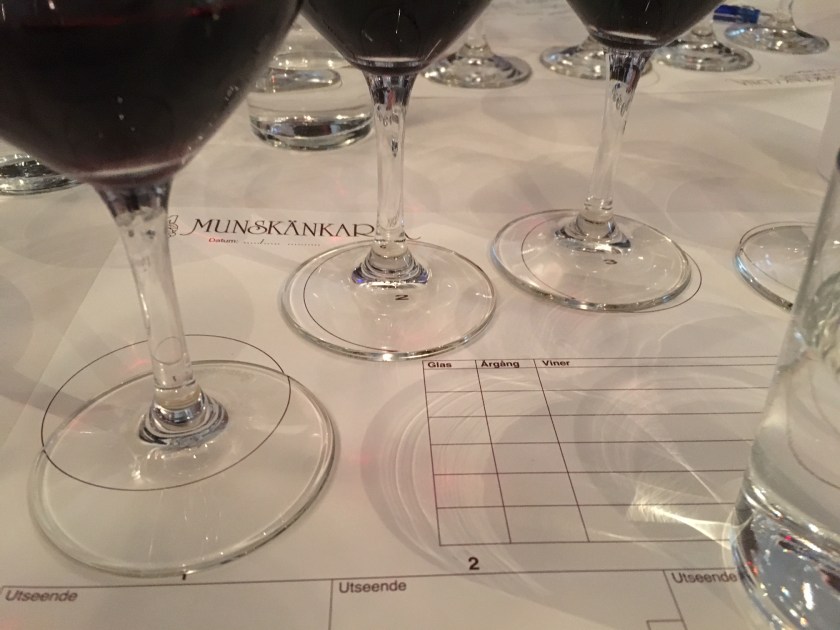
Bordeaux vintage 2003, Munskänkarna, Stockholm

Bordeaux vintage 2003, Munskänkarna, Stockholm – November 2015

After a summary of the climatic conditions of 2003 and its impact on the different appellations in Bordeaux, we are served eight wines. Their identity is known to us but their order is not, and we taste them blind. It transpired that they were poured from the lightest to the more powerful, and incidentally in ascending order of Robert Parker’s scores!

  • Château Grandis, Cru Bourgeois, Haut-Médoc, 178 kr
  • Pavillon Rouge du Château Margaux, Margaux, 1100 SEK (RP 90)
  • Château Haut-Bailly, Pessac-Léognan, Cru Classé, 977 SEK (RP 91)
  • Château Hosanna, Pomerol, 902 SEK, (RP 92)
  • Château Pontet-Canet, Pauillac, 5ème cru classé, 800 SEK (RP 95+)
  • Château Léoville-Poyferré, Saint-Julien, 2ème cru classé, 1100 SEK (RP 96)
  • Château Cos d’Estournel, Saint-Estèphe, 2ème cru classé, 1680 SEK (RP 97)
  • Château Angélus, Saint-Émilion, Premier Grand Cru Classé A, 2000 SEK (RP 98)

In spite of the baking summer, 2003 was considered a good vintage for Bordeaux reds albeit an atypical one. There was much talk as to whether these wines would be able to age. Some thought they might just collapse. Twelve years later we can see that this clearly has not happened. Today critics are divided as to which wines should be consumed soon and which will keep. The general recommendation is too drink them fairly soon. For Robert Parker Angélus and Cos d’Estournel were the superstars of the vintage. Indeed, the Cos d’Estournel showed freshness on the nose and palate. With its lush plum colour, it has a particularly lovely nose with some vegetal, floral, cedar wood and red fruit notes. Lots of fine tannins, pencil shaving aromas, bitter chocolate and evolved fruit. The heat of the vintage has imprinted many Bordeaux wines with power, strong tannins and ripe, dense, jammy red fruit. The latter, ripe cooked strawberries, are present in the Château Grandis, the St-Julien (Léoville-Poyferré) and the Pauillac (Pontet-Canet). The Pontet-Canet, however, also has fresh blueberries and flowers in addition to the ripe red fruit. With nice acidity and good length, this wine is elegant and harmonious. The Hosanna did not show well though. More port than wine, it was oxidised and reminiscent of an aged sake, with flavours of old strawberry cordial, prickly alcohol and drying tannins. This could be down to bad storage as opposed to poor natural development of the wine, and merits another tasting out of a bottle sourced from a different cellar. Alongside Cos d’Estournel, Angélus is the most tannic of the line-up. Its nose is restrained with red fruit, savouriness, herbs and some mint. It provides quite a tannic mouthful but is very silky and imparts toastiness and notes of bitter chocolate. It might very well be reaching its peak and should be drunk soon. At a little over a half of the price of Angélus, Pavillion Rouge’s 2003 does not display baked red fruit. Dark in colour, it has more of the classic Cabernet and Médoc blue tones: blue fruit, cassis, smokey tannins and a good length.

I would have happily drained many of my glasses, and had some food with them – especially the more tannic ones – but had to refrain as I was driving home. I should have known better…

This was an interesting seminar given by Munskänkarna. I will definitely attend future events. My Swedish friends might even come along with me, especially now that I have nailed the pronunciation of the word Munskänkarna, and am able to explain to them that I have joined a wine society and not Munkarna, the monks. Four letters and a world of difference. Or maybe not.

For more information on Munskänkarna visit www.munskankarna.se.

A fine day for Australian wine

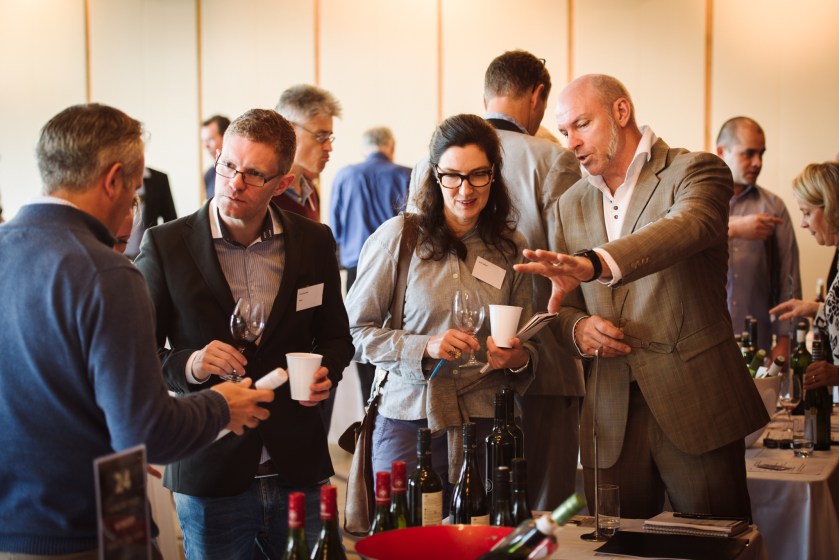
October 1st was World Sake Day, a day to celebrate sake and traditionally the start of a new sake brewing year in Japan. That event appears to have flown under the radar here in Sweden. On the 5th of October, however, it was Australia Day. Not that one was celebrating Australia up and down the country. It was, in fact, the name given by the nordic co-organisers of Wine Australia’s Annual Tasting in Stockholm. More than thirty exhibitors from different wine growing regions in Australia gathered in the Opera house in rooms overlooking a sunny Norrström and The Royal Palace.

A quick glance at the list of exhibitors confirms that the usual suspects are taking part, i.e. Penfolds, D’Arenberg, Hardys, Jacob’s Creek and Lindeman’s to name a few. I make my way around the tables and try to get a feel for any new trend or new angle in this year’s trade show. The welcome note from Australia’s wine marketing body made a point of the country’s diversity, and the theme of the introductory masterclass (reserved for a few trade members) was “History, Evolution, Revolution”. Whether or not that theme was a denominator of the wines presented, change if not revolution was tangible. A couple of weeks after the tasting, Wine Australia published a report (click here for Export Report September 2015)  indicating that the 12 months up to 30 September 2015 had seen growth in the value of exports overtake growth in volumes (8% and 5% growth respectively) with 734 million litres of total exports and a value of A$1.96 billion (12 billion SEK). That value growth rate is the strongest since 2007. Premium wine is the category with the most growth: wines above A$10 (62 SEK) per litre increased in value by 28% to A$426 million (2.6 billion SEK), wines priced between A$20 (123 SEK) and A$50 (308 SEK) increased 13% to A$88 million (542 million SEK) and the top wines above A$50 per litre rose 54% to a record A$133 million (819 million SEK). The average value of bottled exports now stands at A$5 per litre having increased by 4% (www.wineaustralia.net.au). These figures are very good news for Australia that has been focusing on the premium category and fighting hard to shed its image as a producer of inexpensive wine.

How these figures will directly impact the offerings on the Swedish market remains to be seen. At present, Australia is the fifth most important exporter to Sweden in terms of volume behind Italy (1st), South Africa (2nd), France (3rd) and Spain (4th). A general trend for the monopoly in Sweden appears to be a decrease in wines cheaper than 70 SEK per bottle and a significant increase in wines above 100 SEK per bottle. Another marked trend is the increase in sales of organic wine. The latest report from Systembolaget show that third quarter sales of organic wine in Sweden (alcohol-free wine not included) were up 59% compared with the same period the previous year. Australia and the monopoly are steering pretty much in the same direction.

_s_Wine-Australia_Operaterassen-STHLM_5-Oct-2015_131_Screen_2048px_sRGB

Joch Bosworth at Wine Australia’s Annual Tasting, Stockholm. Image courtesy of Wine Australia.

This bodes well for Joch Bosworth, winemaker and owner of the wine label Battle of Bosworth. (If this name rings a bell to English ears, yes, it is the famous battle that put an end in 1485 to the War of the Roses with the death of Richard III – the king whose remains were found a few years ago in a car park in Leicester). Joch Bosworth is an important figure in organic viticulture in Australia. He has been farming naturally for as long as 20 years and was the first organic producer in McLaren Vale. With 80 ha of vineyards at the foothills of the Mt Lofty Ranges in South Australia, he caters for a wide consumer group and produces wines under two labels: Spring Seed Wine Company and Battle of Bosworth. Systembolaget like his organic Spring Seed Wine Company tank fermented “Four O’Clock” Chardonnay and are selling it at SEK 99. They also like the labels on his Spring Seed range – contrary to some in the UK so I was told. The labels are reproductions of vintage flower seed packets and shout organic as well as convey the fresh, fruity flavours of the line. With Battle of Bosworth the winemaker experiments as well as produces classic wines that best reflect the terroir of this premium location. As part of the latter you will find a traditional single varietal McLaren Vale Cabernet Sauvignon aged in 25% new oak and a McLaren Vale Shiraz, Cabernet Sauvignon and Petit Verdot blend that exude purity of fruit. An interesting and exciting wine released on November 2 by Systembolaget is Battle of Bosworth, Puritan Shiraz, McLaren Vale 2015. This wine has no added preservatives. It would not, however, be considered a “natural” wine. Made under reductive conditions and without touching oak, this Shiraz is pure elegance of fruit. If wines with no added SO2 are not a novelty at Systembolaget, there certainly is no search filter on their website that allows you to look specifically for wines “without added sulphites”. A category that will need to be created soon, for sure.

Spring Seed Wine Co, McLaren Vale, South Australia

Spring Seed Wine Co, McLaren Vale, South Australia

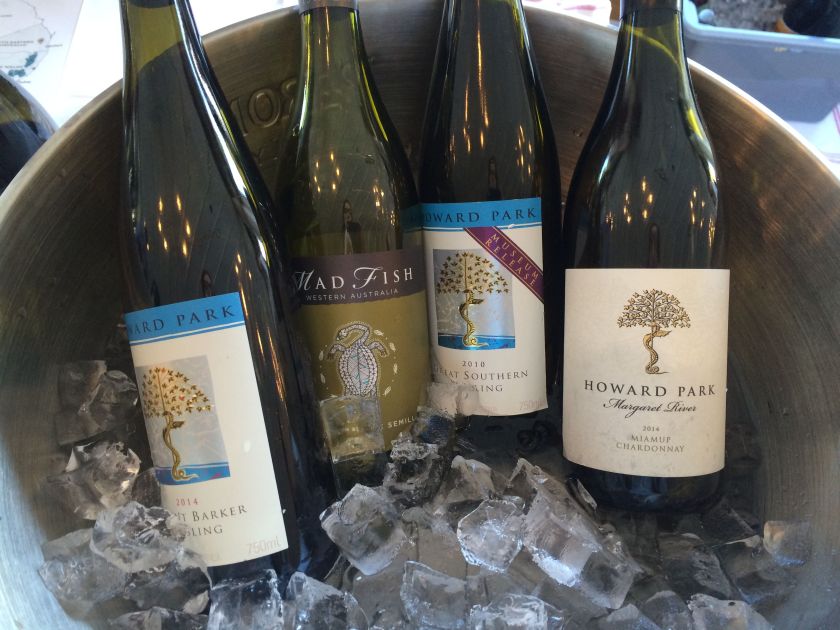
At Western Australia’s Howard Park Wines the mood is of quiet exhilaration. Sue Henderson, commercial director of sales at Burch Family Wines, a company that owns three other labels in addition to Howard Park, tells me that the region is hot. Western Australia produces 4% only of Australia’s wine and is a premium wine state. The wine region surrounds the city of Perth and stretches down to the south tip and along a portion of the south-eastern coast. Benefitting from a mediterranean climate, Western Australia is known for its benchmark Sauvignon Blancs and Semillons. But now it is its dry Rieslings that are highly sought after. Howard Park owns two wineries, one in Margaret River on the western coast towards the Indian Ocean and the other in Great Southern facing the Southern Ocean. Their Rieslings come from vineyards situated in Great Southern, on the coast, with their best plots in the Mount Barker area at a 400 metre elevation. There the climate is cool, and the soils poor. The Rieslings produced are marked by their dryness, fresh acidity, minerality with lashes of lemon and lime curd (Howard Park, Mount Barker Riesling, 2014). With age the wines develop great toastiness and aromas of ripe limes (Howard Park, Riesling, Museum Release, 2010). These wines would be a nice addition to Systembolaget’s selection of Australian Rieslings. As far as I can see there is only one Riesling from Western Australia on offer at this point in time. So that’s me ordering from The Wine Society in the UK…

Howard Park Rieslings, Western Australia

Mouthwatering Rieslings from Howard Park, Western Australia

Which red grape varieties marry the best with Shiraz, Australia’s most planted grape variety? Cabernet Sauvignon? Grenache? If Shiraz/Cabernet Sauvignon is the Australian blend par excellence, Shiraz/Grenache or rather GSM (Grenache/Shiraz/Mourvedre) is another blend that is gaining in popularity. South Australia and California are two regions that are producing their own style of southern Rhône blends. Is the “revolution” alluded to in the masterclass also to be taken as meaning “a circular movement around an axis”? Fifty years ago Rhône varietals ruled Terra Australis before bowing out to Cabernet Sauvignon and other grape types. Today Rhône wines and Rhône varietals are back in fashion.

I make my way over to Mike Brown, winemaker at biodynamic Gemtree Wines in McLaren Vale, who talks to me enthusiastically about Grenache. He tells me that Gemtree has some old, low-yielding bushvines growing on sandy soils that are making beautiful, concentrated table wines. Grenache, which was mainly used up until the sixties and seventies for fortified wines, is being rediscovered and McLaren Vale is making the variety its very own. Cinnabar is the name of Gemtree’s organic GSM that can be purchased at Systembolaget (Gemtree Wines, Cinnabar, 2014, McLaren Vale, South Australia). With his 120 hectares on 23 different soil types Mike Brown vinifies a range of wines including single varietal Shiraz, Chardonnay, Merlot, Petit Verdot to name a few, as well as some interesting blends. Of note the Phantom, a certified organic red blend composed of a different set of grape types at each vintage. In 2012 the blend was 70% Cabernet with 10% Shiraz, and equal amounts of Mourvedre, Tempranillo and Sangiovese. The latest release, the 2014, is 60% Cabernet, 25% Mourvedre, 10% Grenache and 5% Shiraz. If the composition of the blend may be elusive, there is nothing phantom-like in the wine, which has a very strong presence; a deep concentrated, juicy potion with lots of dark and red fruit. Should you wish for a wine in a totally different style, you could try Gemtree Wines Moonstone, a refreshing citrusy wine from Savagnin, the Jura grape variety used for Vin Jaune… The Australians are certainly full of surprises…

Mike Brown, Gemtree Wines at Wine Australia's Annual tasting, Stockholm. Image courtesy of Wine Australia.

Mike Brown, Gemtree Wines at Wine Australia’s Annual tasting, Stockholm. Image courtesy of Wine Australia.


Wines of Macedonia, the doppelgänger from the Balkans

This week was the trade tasting for wines from Macedonia. Not wines from Macedonia in Greece but from the Former Yugoslav Republic of Macedonia (FYROM) or Republic of Macedonia as it is officially called. If the country, confusingly, shares its name and a border with a Greek region, its wines could not be more different. In the Republic of Macedonia you will not encounter, as you do in northern Greece, Xinomavro, Negoska or Assyrtiko. Instead, the grape varieties are mainly a mix of classic French and local ones. These include Chardonnay, Sauvignon Blanc, Cabernet Sauvignon, Syrah and Merlot for the international grape varieties and Vranec, Temjanika, Zilavka, Kratoshija, Plavac Mali for the local varieties.

Located in the Balkans, the country does not touch a sea. It is enclosed by Albania on the west, Kosovo and Serbia on the north, Bulgaria on the east and Greece on the south. Its capital is Skopje. The country is fairly mountainous and is cut across from north-west to south-east by the valley of the Vardar river. The Vardar river originates in Vrutok, not far from Albania and Kosovo, flows through Skopje, winds itself down the country, before entering Greek Macedonia (where it is known as Axios) and throwing itself in the Aegean sea, west of Thessaloniki. This valley is an important throughway from Greece to Serbia and Macedonia’s main motorway runs along it. The climate is mediterranean and continental. In the summer temperatures can reach up to 45°C during the days with not much rain. Winters are moderately cold.

There is an ancient tradition of winemaking in Macedonia. With a total surface area of 25’713 km², the country has 25’000 hectares of vines, which is not inconsequential. By comparison there are 15’500 ha in Alsace and approximatively 46’000 ha in Austria. Annual wine production was 125 million litres in 2014 with most of it being red. This represents 3-4% of world production. The majority of wine is exported and is an important source of revenue for Macedonia.


The biggest wine producer in Macedonia is Tikves (Tikvesh) Winery located in the fertile plain of the Vardar river in Kavadarci. Tikvesh takes its name from the nearby lake and surrounding region. According to Wines of Macedonia, the winery owns 1’000 ha of vines and works with external grape growers on an additional 3’000 hectares of vines. Annual production is 12 million bottles but the winery has a capacity of up to 30 million bottles. Their representative tells me that this year’s harvest, which is practically finished, is set to yield 25 million kilos of fruit. Tikves is working with the French consultant Philippe Cambie.

Tikves Winery, Republic of Macedonia

Tikves Winery, Republic of Macedonia

Tikves Winery, Rkaciteli Special Selection 2014, 13% abv.
Rkaciteli is an ancient Georgian grape variety. It is found across the ex-Soviet states. It is the most planted variety in Georgia and Ukraine and also significantly in Bulgaria, which is just across the border from Macedonia.
26’000 bottles produced (2’166 cases)

Tasting note: Floral, grapey, peachy, apricot-like on the nose.  Hints of peach, quince, grapes and apple-skins on the palate, light in body with a dry finish. 

Tikves Winery, Vranec Special Selection 2013, 14% abv.
The winery’s intention with this bottling is to produce a wine that is inexpensive and that displays the true identity of the grape variety. The wine has therefore not touched oak. The grapes are sourced from a couple of vineyards. The grape variety is Vranec (pronounced Vrahnets). The name means “black stallion”. It is now the most important red grape variety in Macedonia but is thought to have originated from Montenegro. DNA research has revealed that it is related to Tribidrag otherwise known as Primitivo or Zinfandel.
120’000 bottles produced (10’000 cases)

Tasting note: Reddish purple in colour, dusty, dense dark and red fruit yet fresh and delicately focused with supple tannins and a dry finish.

Tikves Winery, Barovo red 2012, 14.5% abv.
This wine belong’s to the winery’s top range. It is a blend of Kratoshija and Vranek.
The grapes come from a single vineyard, in mountainous terrain, 600 meters above sea level. The wine has been aged in new (40%) and one vintage old (60%) oak casks from France, one of the coopers being Seguin Moreau from Cognac.
Kratoshija is a grape variety that originated in Croatia in central Dalmatia where it is known as Tribidrag. In Montenegro it goes under the name of Kratoshija, in southern Italy Primitivo and in California Zinfandel. It is related to Vranek, but the latter has bigger berries, more tannins and more acidity.
36’000 bottles produced (3’000 cases)

Tasting note: Intense purple black in colour, smooth, powerful, dense and succulent with plums, ripe dark fruit and supple tannins.


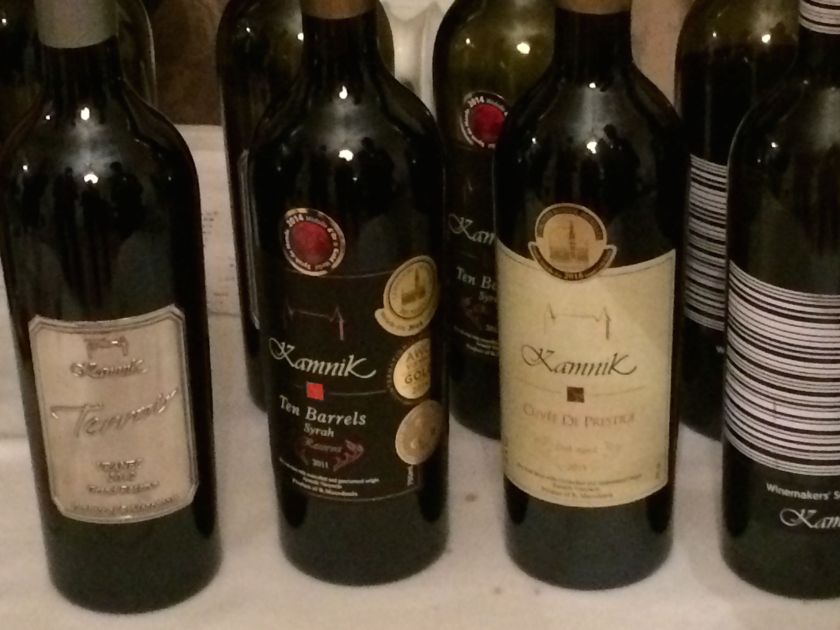
Château Kamnik, or Kamnik Winery is located in the Vardar River Valley in proximity to the capital, Skopje. It harvests 23 ha of vines, out of which 13 ha are self-owned.

Kamnik Winery, Republic of Macedonia

Kamnik Winery, Republic of Macedonia

Château Kamnik, Temjanika 2014, 13.5% abv.
This white wine is made from the Temjanika grape variety. It is a common varietal in Macedonia and in other countries in the region. It is another name for the old Mediterranean variety, Muscat, that probably originated in Greece or Italy.

Tasting note: Light rose petal and orange blossom, a little bitterness, quite a bit of body, a warm finish with a little toastiness.

Château Kamnik, Montepulciano 2013, 14.2% abv.
The chosen grape variety is here the high yielding and dark coloured Italian Montepulciano.

Tasting note: Sweet candy nose, loukoum, red cherry. Smoky, meaty, dry with plums, cherries and coffee. Textured and heady.

Château Kamnik, Terroir Vranec Grand Reserva 2012, 16.2% abv.
A pure Vranec varietal wine, it spent 25 months in French and American oak.

Tasting note: Very dark in colour, a deep dense texture, tannic, with ripe dark fruit, plums, and sweet vanilla. Somewhat overpowering.


Stobi Winery is quite a big sized operation that was established in 2009. It owns and cultivates 600 hectares of vines in the Tikvesh region of Macedonia. It produces 4.5 million litres of bottled wine (figures from Wines of Macedonia). Their winemaking is traditional but their winery has state of the art equipment. It is located in Gradsko, close to the ancient city of Stobi. Strategically built at the juncture of the Crna and the Vardar rivers, on fertile terrain, Stobi was in the Antiquity the main town of the Kingdom of Paeonia before becoming the capital of the Roman province Macedonia Secunda. With its many ruins and artefacts from different civilisations, it is today considered the most important archeological site in Macedonia.

Stobi Winery, Zilavka 2014, 11.5% abv.
Zilavka is an indigenous white grape variety from Bosnia and Herzegovina. It had become nearly extinct. Two or three wineries have adopted it in Macedonia and are bringing it back to life. The grape might be related to the Italian Prosecco variety.
Annual production: 130’000 litres

Tasting note: Fresh, floral, citrusy, Muscat-like notes, very pretty, light in body, dry and refreshing and slightly unusual.

Stobi Winery, Chardonnay 2014, 13% abv.
Made in stainless steel.
200’000 bottles produced

Tasting note:a classic style cool unoaked Chardonnay. Quite a lean body with lots of refreshing notes of green apple, lemon and stone fruit.

Stobi Winery, Vranec 2014, 13% abv.
Made 100% from the Vranec grape variety. Manual harvest.  Temperature controlled fermentation and ageing of part of the wine for 9-11 months in different sized oak barrels.
Annual production: 210’000 litres

Tasting note: Dark purple with very coloured legs. Dense texture, soft spicy intense dark fruit, brambly, earthy, mushrooms and a dry finish.

Stobi Winery, Vranec Veritas 2011, 14.5%
Vranec Veritas was made from low yielding vines (1 cluster per shoot). Manual harvest with sorting at the vineyard. Temperature controlled fermentation. Wine aged for 2 years in Slavonian oak barrels of different sizes (225 litres and up).
Annual production: 30’000 litres

Tasting note: Dark coloured. Brambly, super concentrated, soft juicy moorish dark fruit, with an earthy, dry, savoury finish and gentle tannins.

To find out more visit:

  • Wines of Macedonia (www.winesofmacedonia.mk)
  • Exploring Macedonia (www.exploringmacedonia.com)
  • Archeological site at Stobi (www.stobi.mk)

To source Macedonian wine world-wide:

To check availability of Macedonian wine in Sweden:

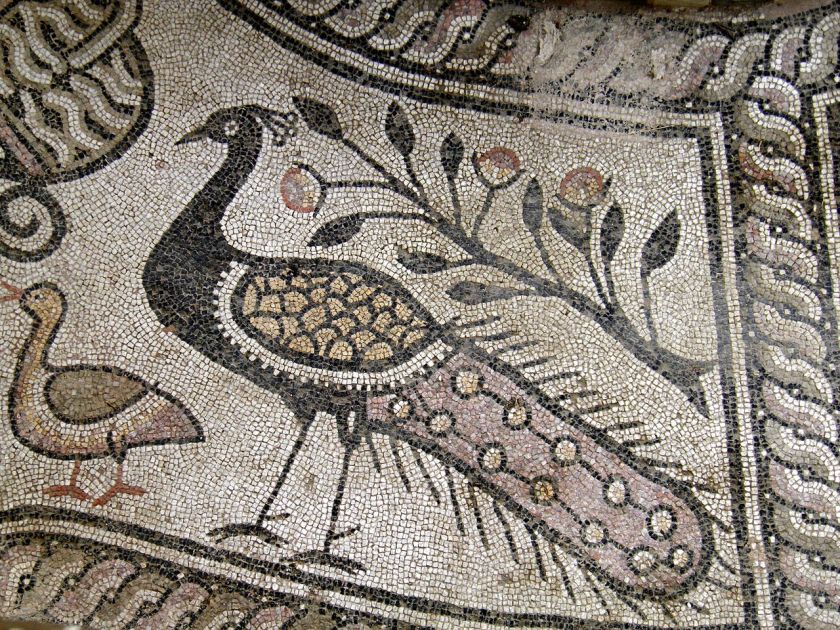
Featured image: Mosaic floor decorated with a peacock in the baptistery of the Episcopal Basilica, Stobi (7359173306) from Wikimedia Commons

An escape to Greece – a narrative

It had been a long time since I last went to Greece but I still have vivid memories of summer holidays spent there. Happy childhood days clambering freely over the Acropolis, wandering through the ruins of Knossos, sitting on the throne of King Minos, eating juicy chunks of watermelon on a hot, dusty road. I returned later as a young adult, fresh from secondary studies in classics, and hiked around the south coast of Crete. Then, whenever my travelling companions and I stopped for a meal and refreshments, we were invariably offered Ouzo, Retsina or Metaxa. Food was more often than not basic and rather greasy. Communication was carried out in a mix of ancient and modern Greek.

Pithoi at Knossos, Crete

Pithoi (storage jars used for olive oil, wine, grain) in Knossos, Crete

How things have changed. During this summer’s vacation I did not have a single bad meal and not once was I recommended retsina. Restaurants served up a selection of succulent traditional and innovative dishes made from fresh local produce. There never was any problem in shops or when ordering food as everyone spoke English. As far as alcoholic beverages were concerned, Ouzo and Retsina have clearly lost the popularity contest to Greek wine.

The Greek wine industry has been going through a process of regeneration, rediscovering its wealth of indigenous grape varieties, and making use of new technology. There is plenty of innovation and experimentation at hand. As a result, Greece is today producing some fantastic wines that are not only high in quality but also totally individual. The country is reconnecting to its past. Wine is regaining its place in Greece’s cultural identity.

To find out more about Greece’s wines was partly what motivated me to choose the country as my holiday destination. It was, for me too, a reconnection to my past, a rekindling of neglected interests. This choice, however, proved particularly judicious: the rest of the family was thrilled. We spent two weeks enjoying wonderful weather, lovely beaches, good sightseeing, delicious food and wine, and fantastic hospitality.

Leaving a cool scandinavian summer behind us, we land at night in Athens, suddenly to be engulfed by heat and lively hubbub. A pleasing sensation of being somewhere foreign, where life operates in a slightly different or unexpected way, overcomes us. We amuse ourselves in deciphering signs and maps, and decide to take the bus from the airport to the centre of town. We sit on the bus, in total darkness, as the driver waits for more passengers. Finally, the engine switches on, along with some dim lighting, and we depart following a non-disclosed timetable.

Some three-quarters of an hour later we alight on the moon-bathed marble of Syntagma Square, and despite the late arrival of our plane we just make it to the hotel before the restaurant closes, and enjoy a Greek omelette and a bottle of Tselepos Moschofilero.

Tselepos Classic, PDO Mantinia 2011, Moschofilero

Tselepos Classic, PDO Mantinia 2011, Moschofilero

Tasting note: Tselepos Classic, PDO Mantinia 2011, 12% abv. This wine is made from Moschofilero. This is an aromatic grape variety that has a coloured skin. It produces wines that are characteristically fresh, lively, light, not too high in alcohol, with a floral and grapey flavour profile. The wines are usually drunk young. The wine we had here is from 2011. I  am not sure whether the vintage was a conscious offering or an accidental one on the part of the restaurant. There was no vintage specified on the wine list… After initial surprise over the vintage, I was curious to see how the wine would have evolved. A deep warm straw colour, the wine displayed freshness and fragrances of delicate honey, raisins, dates, hazelnuts, thyme. On the palate, oxidative, sherry-like yet fresh aromas mingled with some sweetness and apple skin. 

Athens - Syntagma Square

Parliament building and Syntagma Square, Athens

We wake up to a hot day and a view over the now quiet Syntagma (Constitution) Square and Parliament building. We have given ourselves one full day of sight-seeing in Athens before heading off to the islands. From our hotel we walk a little way up, past the elegant residence and gardens of the French Embassy to the Benaki Museum, which houses on the ground floor a permanent collection of mesmerising Greek art from the prehistoric times to the 3rd century A.D. After a pleasant lunch on the museum’s roof terrace, we set off through the narrow streets on an upward climb to the Acropolis. In spite of the important restoration work and scaffolding, the site remains as breathtaking as ever.
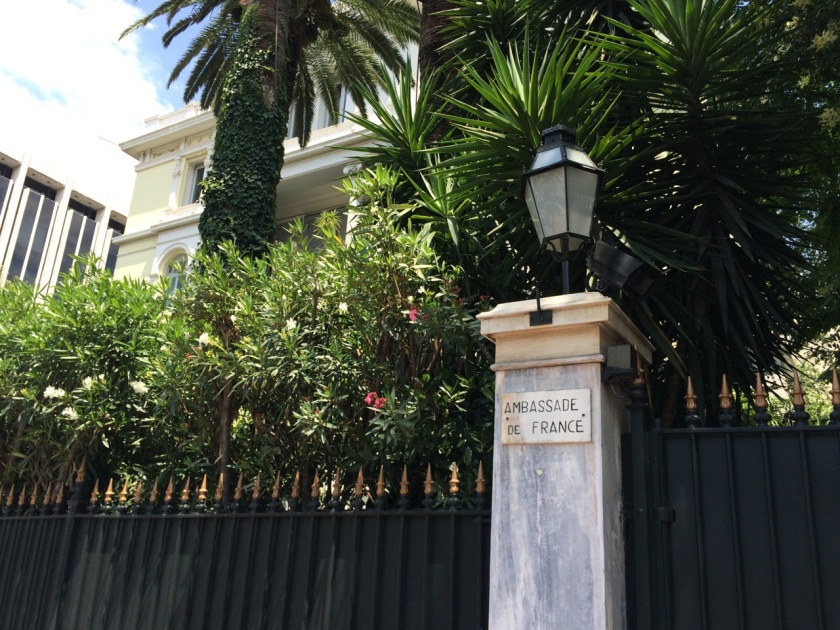
Ambassade de France, Athens, Grece

French Embassy, Leoforos Vassilissis Sofias, Athens

Red figure pottery from the Benaki Museum, Athens

Red figure pottery with dancing maenad at the Benaki Museum, Athens
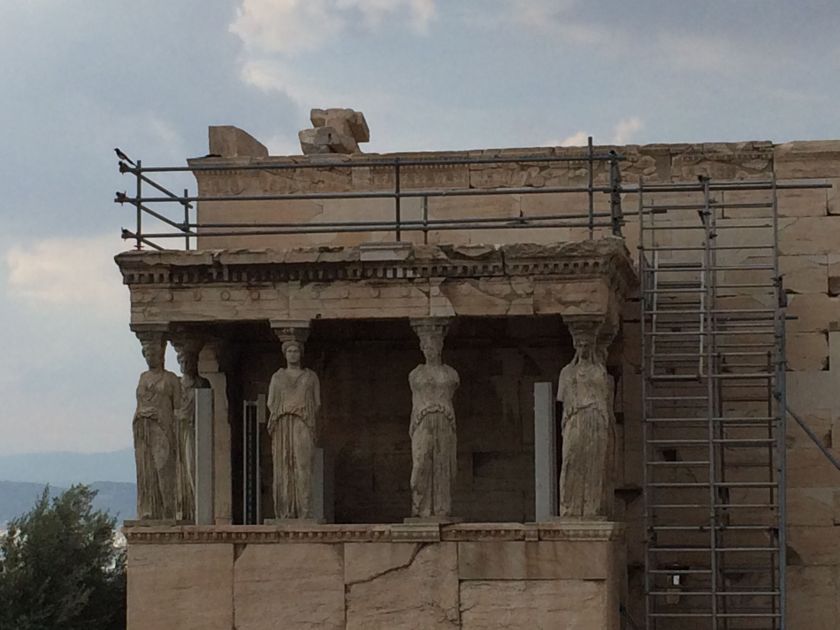
The Erechteion, Acropolis, Athens

The Erechteion, Acropolis, Athens

Entrance to the Acropolis, Athens

Entrance to the Acropolis, Athens

The Parthenon, Acropolis, Athens

The Parthenon, Acropolis, Athens

In the evening we traitorously exit our hotel only to walk straight into the one next door. It has an asset that our hotel doesn’t: a roof terrace with a restaurant. There we have supper facing the floodlit Acropolis. In the meantime demonstrators are starting to gather in the square below… If the food at the hotel – in keeping with the prevailing politics – seemed to be suffering from a slight identity crisis, unsure whether it should be outright Greek or suffused with a mix of European cuisines, the wine list offered an appealing selection of new Greek wines. We were tempted by a red Mavrotragano by Sigalas, but food and weather called for a refreshing thirst-quenching white Moschofilero by Seméli.

Seméli, Nassiakos, PDO Mantinia 2014, Moschofilero

Seméli, Nassiakos, PDO Mantinia 2014, Moschofilero

Tasting note: Seméli, Nassiakos, PDO Mantinia 2014, 12% abv (Moschofilero). Pale gold in appearance. Fresh lemonade, Galia melon, honeysuckle, rose petal, Loukoum on the nose. Refreshing acidity and light in body, Gewürztraminer-like with aromas of Peach Melba, apricot and rose water on the palate. 

The following morning a 40 minute dawn taxi ride takes us to Rafina harbour and we embark on a hydrofoil bound for the island of Paros. After quite a bumpy ride on a beautiful blue sea criss-crossed with white horses, we arrive at our destination. We weave our way from the quay to the main street through a whirlwind of lost holiday makers, suitcases, honking cars, donkey carts, and a throng of Greek taxi drivers and car rental agents come to greet the passengers off the ferry. One of them is Nick, who manages to spot us in the flurry. He hands us the keys to our rented car and away we drive. It’s only a short car journey away from the port in Parikia to our hotel in Kolymbithres.

Our four day stay on the island turns out to be way too short. Located in the Aegean Sea, Paros is one of the biggest of the Cycladic islands. These 56 islands are so named as they are spread out in a circle around the island of Delos, the birthplace of Apollo and Artemis, now a Unesco World Heritage site. Like many islands Paros has been invaded and inhabited by many different civilisations and has a rich past.

There is more to see on the island than one might expect. Today the main source of wealth of the island is tourism. In the Antiquity it was marble and it brought fame to the island. Parian marble was sought after for its beautiful fine grain, its flawlessness and white translucency. It was used by many Greek sculptors during the Classical period and it is believed to be the stone out of which the Venus de Milo has been carved. The quarries are no longer exploited but they can be visited and are situated in the village of Marathi, east of Parikia. Ten minutes away by car from Marathi, right in the centre of the island, up in mountainous terrain, lies the village of Lefkes. Once the capital of the island, it is worth a detour for its traditional houses, Byzantine church, and Venetian architecture. If one is interested in Byzantine art, the lively capital, Parikia, has a small museum devoted to it.

Kolymbithres, where we chose to stay, is located in a bay in the north of the island. Our hotel is built in the traditional style: little separate houses with white-washed exteriors, small windows with shutters to keep the strong sunlight out and a patio to enjoy a drink in the balm of the evening heat.

Hotel Kouros, Kolymbithres, Paros

Hotel Kouros, Kolymbithres, Paros

The pool at Hotel Kouros, Kolymbithres, Paros

The pool at Hotel Kouros, Kolymbithres, Paros

The area is renowned for its beautiful beaches and coves. White sand or eroded rocks, clear turquoise, aquamarine shallow waters that stretch far out and provide a foothold for unsteady swimmers. Bringing perfection to the setting are the constant breezes that keep the skies blue and temper the heat.

Port in Naoussa

Port in Naoussa, Paros

Fishermen in Naoussa

Fishermen repairing nets in Naoussa, Paros

Fish restaurant in Naoussa, Paros

Naoussa harbour, Paros. Not today, thank you.

Further along the bay, opposite Kolymbithres lies the small fishing town of Naoussa. Charming, narrow, windy pedestrian streets paved with slabs of grey stone, small white-washed houses with brightly painted doors and window frames. In the heat of the day people amble through the town, gravitating around the central square, where they browse in the paper shop and stop for coffee. In the evenings the whole town is alive with tourists who stroll along the quayside, walk up and down the maze of streets, exploring the small boutiques, peering at menus and in people’s plates in search of the right restaurant. There are plenty of restaurants in Naoussa. The really good ones though get booked up pretty swiftly and need to be reserved a number of days in advance.

Soso restaurant, Naoussa, Paros

Soso restaurant, Naoussa, Paros

The two best ones in Naoussa are undoubtedly Soso and Yemeni. Both are family run restaurants that serve Greek food using fresh seasonal and local produce. On our first day on Paros, we got hopelessly lost looking for Soso. We walked through quiet unattractive back street and ended up in the wrong restaurant, which was devoid of diners and where the owner begrudgingly pointed us in the right direction. Finally, we found our table, tucked away in an alley, up against a typical traditional white cycladic house with deep pink bougainvillea tumbling from above. Luckily our reservation had been kept, the place was buzzing with diners chatting and munching happily away.

Food, of course, is the perfect prompt for trying new wine. Both Soso and Yemeni have a good selection of reasonably priced Greek wine.

Santo Wines, Santorini PDO, Nykteri 2014 at Soso restaurant, Naoussa, Paros

Santo Wines, Santorini PDO, Nykteri 2014 at Soso restaurant, Naoussa, Paros

At Soso we tried a white blend, Nykteri, PDO Santorini, 2014, 14% abv, produced by Santo Wines, the cooperative on the island of Santorini. The main grape in the blend is Santorini’s indigenous, star variety: Assyrtiko. The wine is refreshing, crisp and citrusy. The power and incisiveness that Assyrtiko can display is here toned down by the other two grape varieties, Athiri and Aïdani, that add some softness to the blend.

Moraitis, PDO Paros, 2013, Monemvasia, at Yemeni restaurant in Naoussa, Paros

Moraitis, PDO Paros, 2013, Monemvasia, at Yemeni restaurant in Naoussa, Paros

At Yemeni the food is more Greek traditional and includes deliciously prepared dishes such as feta parcels wrapped in filo pastry, smoked aubergine salad and kebabs. The wine list comes on a small, slightly crumpled, lined notepad handwritten in blue pen. Wanting to taste both a white and a red, we asked the owner Nikos for recommendations of wine-by-the-glass.

The white wine, excitingly, is from Paros: Moraitis, PDO Paros 2013, 13% abv. Smoky, lemon and lime cordial, almond paste, Bassett’s blue liquorice, citrus with a hint of bitter lemon peel and soft acidity. The richness of the wine was achieved through a six months on the lees barrel maturation. The grape variety, which takes its name from a port in Laconia in the Peloponnese where it probably originated, is Monemvasia. It grows in the Cycladic and Aegean islands but mainly on Paros where it is one of signature grapes of the Moraiti Winery. As it turns out, the Moraiti Winery is located in Naoussa. It is all set up for visitors with a small museum, large tasting room and great hospitality (www.moraitiswines.gr). Find out more on Moraiti winery in a forthcoming blog post.
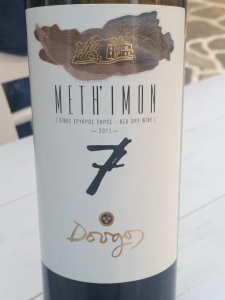
Dougos, Meth'Imon 7, 2011, Greece

Dougos, Meth’Imon 7, 2011, Greece

The red wine was a big gun, so named Meth’Imon “7” as seven grape varieties, both French and indigenous can go into its making: Limniona, Syrah, Grenache, Cabernet Franc, Merlot, Cabernet Sauvignon, and Batiki. Deep purple in colour, succulent, complex, supple, sweet yet fresh, spicy dark fruit, plums and vanilla, this award-winning wine comes from the Dougos Winery in central Greece. The vineyards are located on the slopes of Mount Olympus.

Ktima Biblia Chora, Ovilos 2014, PGI Pangeon, Greece

Ktima Biblia Chora, Ovilos 2014, PGI Pangeon, Greece

Ktima Biblia Chora’s Ovilos 2014, (13.5% abv) was another super wine tasted in Naoussa. Not only beautiful in appearance with its colour of intense pale gold, but also expressive and full-bodied on the palate. The wine is barrel fermented and is a blend of Assyrtiko and Semillon. A combination that works incredibly well and that produces notes of honey, apricot, white peach, lemon and lime with a backbone of zesty acidity. The wine is from the Biblia Chora estate in Macedonia, northern Greece, in the area of the Pangeon mountain. Away from its place of origin, it is not uncommon for Assyrtiko to be blended with international grape varieties. Indeed the Pangeon Protected Geographical Indication (PGI) includes many international grape varieties such as Chardonnay, Sauvignon Blanc, Semillon, Cabernet Sauvignon, Grenache, to name a few,  along with Greek ones.
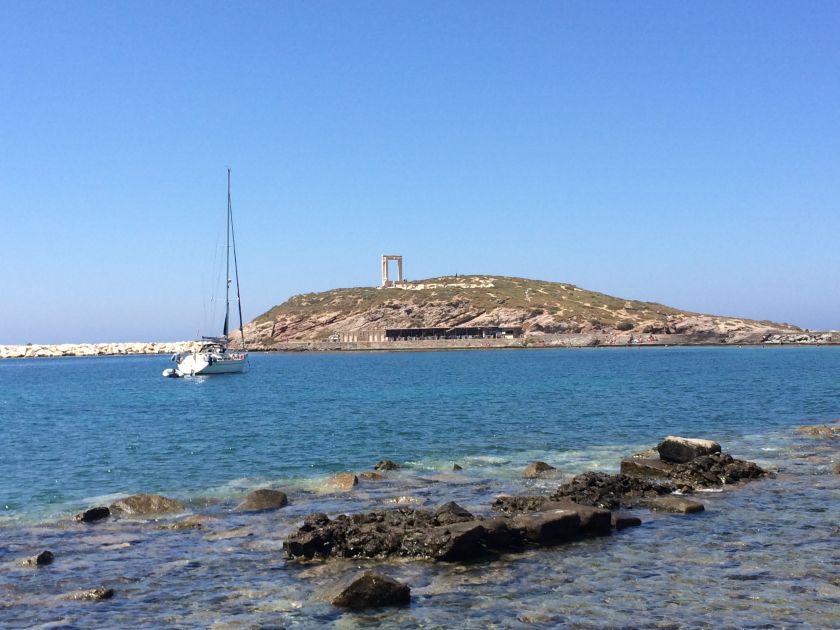
The Portara, doorway to the unfinished temple of Apollo at Naxos, Greece

The Portara, doorway to the unfinished temple of Apollo at Naxos, Greece

Naxos harbour, Greece

Naxos harbour, Greece

Before returning to Athens, we spend a long week-end in Naxos. The biggest island of the Cyclades, Naxos makes a strong visual impact with its striking landmark, the doorway to the temple of Apollo, which juts out and greets you as you sail into port. It is also the island on which Ariadne, daughter of King Minos of Crete, was abandoned by Theseus after she helped him kill the Minotaur. According to some versions of the myth, Ariadne then wed Dionysos, god of wine. Despite its mythogical connections, Naxos does not have a notable wine production. It is, however, renowned for its vegetables, potatoes in particular, meat and dairy produce. It is also a favourite spot for windsurfers and has especially strong winds, which we witnessed first hand during our boat crossing, notably between the coasts of Paros and Naxos.  There is here much to visit on Naxos and for that a car is necessary.

We opted for total relaxation and chose a boutique hotel with a pool and a restaurant -recommended, incidentally, by the travel section of The Telegraph newspaper – and we stayed put. We were not disappointed. Kavos Hotel at Agios Prokopios is a gem of a hotel. Tastefully decorated villas, a welcoming staff, delicious food (fantastic breakfasts), a good wine list and lovely pool.

Kavos Hotel on Naxos, Greece

Individual villas at Kavos Hotel, Naxos, Greece

Kavos Hotel poolside on Naxos, Greece

Poolside restaurant at Kavos Hotel on Naxos, Greece


Moraitis Sillogi 2014, PGI Cyclades, Greece

Moraitis Sillogi 2014, PGI Cyclades

Moraitis Sillogi is one of the wines that we bought at the winery in Paros and that we drank at sunset on our terrace at Kavos hotel before going for supper. The hotel, however, also happens to have it on its wine list and it is no surprise.

Moraitis Sillogi 2014, PGI Cyclades is a crowd pleaser. Pale lemon green in colour, floral notes, with sweet ripe lemons, grapefruit, green apple, a smooth body, refreshing acidity and a dry backbone. The wine is made from organically grown grapes and is an Assyrtiko-Malagousia blend.


Pavlidis Thema 2013, PGI Drama

Pavlidis Thema 2013, PGI Drama

Ktima Pavlidis Thema White 2013, PGI Drama (13% abv) is another Assyrtiko blend. It shares similarities with the Ktima Biblia Chora Ovilos. It is from Macedonia in northern Greece and is blended with an international grape variety, in this case not Semillon but Sauvignon Blanc.

The aromas and fragrances of this wine are all vegetal and citrusy. Fresh lemon, lime flavoured boiled sweets, asparagus and green bell pepper are interwoven in this full-bodied blend with a racy acidity and zesty finish.


Air connections to Stockholm not being that convenient we take a hydrofoil back to Athens. The Referendum vote has closed the day before and the city is electric. The place is crawling with journalists of all nationalities. In our hotel every room overlooking Syntagma Square is occupied, primarily by the press who have set up their lights and cameras on the balcony for news broadcast. You have to watch your feet in the lobby for fear of stumbling over tripods or cameras. We try a restaurant around the corner and here too, cameras and tripods are lying casually amongst the tables.  At 10h30 pm all the tables are taken and we have to wait.

O Tzitzikas ki o Mermigkas, Athens, Greece

O Tzitzikas ki o Mermigkas, Athens, Greece

We toast our last night with a Santorini Assyrtiko from Sigalas to accompany the modern Greek (and occasionally slightly wacky) cuisine of O Tzitzikas & Mermigas. On our table a vegetable mille-feuille with Mastelo cheese from Chios, grilled vegetables and a basil dressing; meatballs with fresh mint and fried potatoes; “Mastihato” chicken fillet in a kadaifi pastry nest with Chios mastic sauce and bacon. An echo to the bounteousness of the Cyclades, the Sigalas Santorini PDO 2014 is a pure Assyrtiko: pale lemon colour in appearance, a touch of limes, citrus, yellow apples, wet stones on the nose; on the palate pure minerality, high acidity, saltiness, a little oiliness and some lactic undertones.

Sigalas Santorini PDO, 2014 - Assyrtiko

Sigalas Santorini PDO, 2014 – Assyrtiko

How to get there
Aegean Airlines
Scandinavian Airlines
Paleologos ferries (www.paleologos.gr)
Akropolis car rental, Parikia, Paros (www.acropolisparos.com)

Where to stay
NJV Athens Plaza Hotel (www.njvathensplaza.gr)
King George Athens (www.kinggeorgeathens.com)
Hotel Kouros, Naoussa, Paros (www.hotelkouros.gr)
Kavos Hotel, Naxos (www.kavos-naxos.com)

Where to eat
King George Athens
Tzitzikas & Mermigas, Athens (www.tzitzikasmermigas.gr)
Soso, Naoussa, Paros
Yemeni, Naoussa, Paros

Where to visit
Benaki Museum
Goulandris Museum of Cycladic Art
The Acropolis
Moraitis winery, Naoussa, Paros (www.moraitiswines.gr)

Where to source Greek wine
http://www.wine-searcher.com

Ochi at Syntagma Square, Athens, Greece

Post Referendum, Syntagma Square, Athens
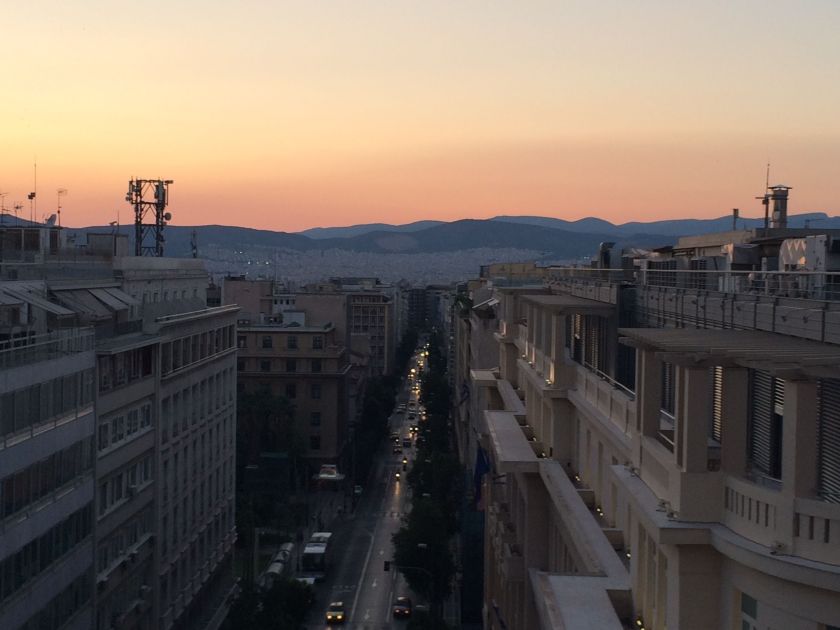
Athens at night

Athens at night

All images by Sarah Jefford


Wizardry in the kitchen at Gastrologik

The night was dark and frosty as we set out for our evening meal. A table had been booked and was waiting for us. Our hearts were beating a little fast as we were running late but also in anticipation of our meal. Not one of us had been there before. We had walked past many times, but the long white undulating and impersonal curtains stared back and revealed nothing. We arrive at the front door and peer through the window pane down the corridor. We glimpse some activity at the far end, dashes of white movement amongst glistening steel. A waiter comes to greet us at the entrance and accompanies us to our table. We make our way past the long wooden fronted workbench where chefs stand hunched over pots and saucepans.


The kitchen at Gastrologik

Gastrologik, Stockholm

We seat ourselves and as we are poured a thirst-quenching glass of the house champagne, 2007 vintage Deutz, we are quizzed as to whether we have dined here before. To the answer “no”, the waitress looks at us enigmatically and glides off to fetch us the menu. We open it, only to discover a blank page, with the inscription “Let today’s produce decide”. With that we are given one clue: the dishes would be made from some of the produce displayed on the sideboard. We recognize root vegetables and spot some jars and clear bottles filled with unidentifiable dark and amber coloured liquids (but luckily no viper tongues nor rat tails).


Toasted spelt bread with homemade cream cheese and Gotland truffle

Toasted spelt bread with homemade cream cheese and Gotland truffle

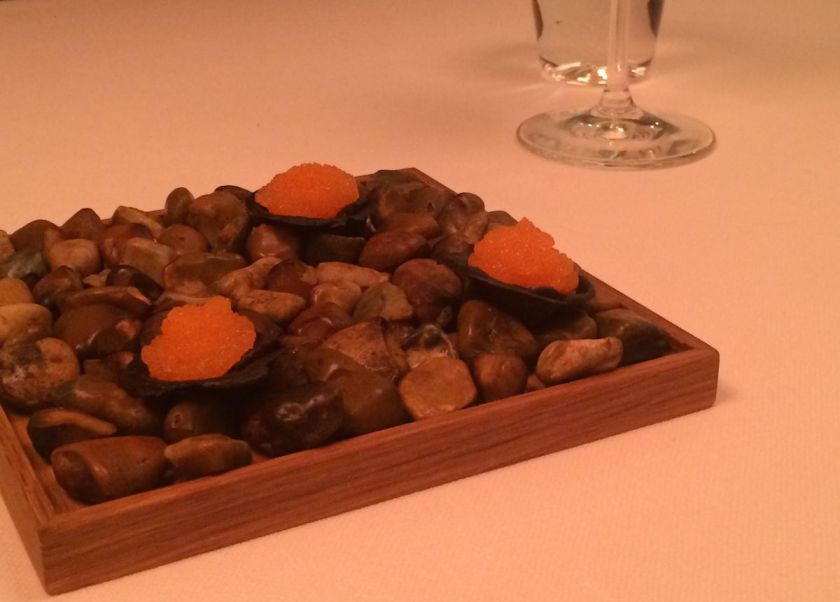
After some tasty bread, we are served the first of our appetisers, a cracker made from reindeer blood served with roe and sour cream. That dish was to set the tone for the entire supper: unusual ingredients, startling combinations, subtle and novel taste sensations.


Reindeer blood cracker with vendace roe and sour cream

Reindeer blood cracker with vendace roe and sour cream

We barely have time to recover from the surprise of the first appetiser – can a cracker really be made from blood, and reindeer blood to boot, yet be very tasty – when four more appetisers follow in seamless succession. Chicken liver with meringue and apple, Quail egg marinated in homemade pea soy sauce, Raw mushroom with a cream of toasted yeast, and an Algae broth with lovage.


Each dish is beautifully presented, tantalising both sight and taste. The flavours are earthy, yet delicate. Ingredients are revealed in a new light and rediscovered afresh: had one ever previously realised how perfumed, delicate and sweetly crunchy a mushroom was? Can an apple be prepared in such a way that it becomes the essence of apple? The very fruit that evokes the autumnal and winter months, the resting earth, forests, smoke and the crisp air?

While some ingredients appear totally unlikely – toasted yeast – others are long forgotten. Lovage, a plant belonging to the parsley family, was popular in the Middle Ages and was used for its culinary as well as medicinal properties. Today it is under the influence of Japan, cooked in a soup blended with seaweed. Served hot it signalled a transition in the meal and prepared the palate for the warm main courses.


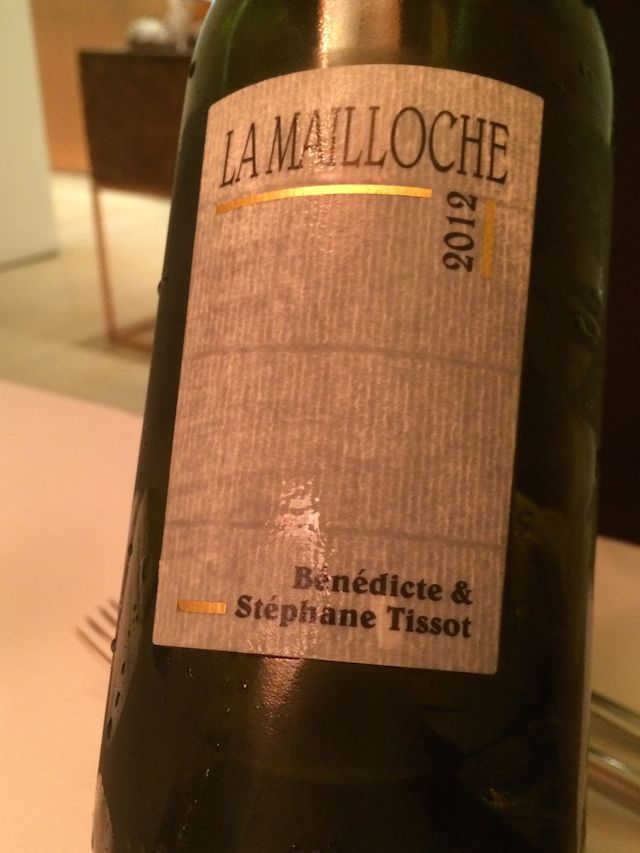
LaMailloche
A waitress brings us some fresh glasses and serves us a French biodynamic Chardonnay from Arbois in the Jura produced by Domaine André et Mireille Tissot and vinified by the couple’s daughter-in-law and son. Pondering on what would be served next, we glance towards the kitchen when a bearded chef from a foreign land appears with the next course, a beef tartar with ashes of hay. But this is no ordinary meat. It has been sourced not just from a known farm but right down to a specific cow. And in this instance it was poor Silvia.


Tartar from the cow Silvia with hay ashes

Tartar from the cow Silvia with hay ashes

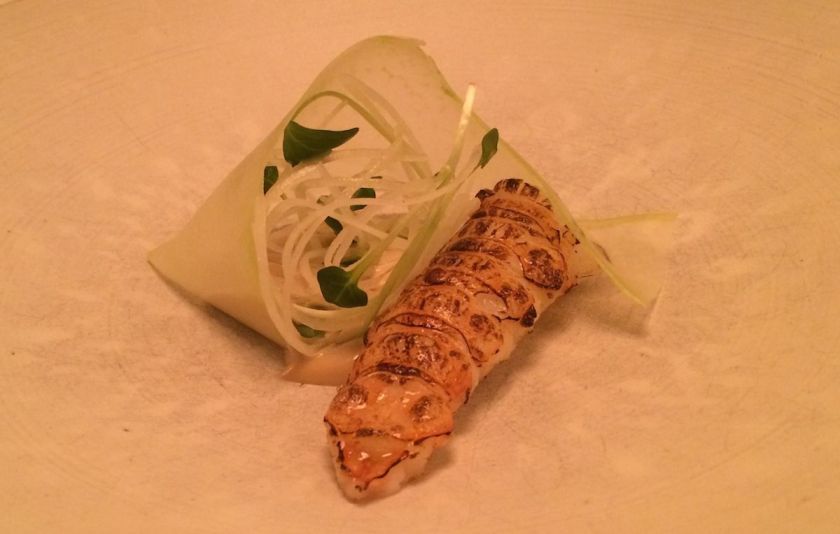
After the unusual tartar, we assume that the meal is coming to a close, but it is in fact only the beginning of a sequence of seven dishes, each one more phantasmagoric than the other. A razor clam-looking grilled leek served with Japanese udon noodle-like squid, a langoustine parading as a sea serpent and a Miró inspired arctic cod and pickles.

The descriptions given for a few of the courses are somewhat gory and could have come straight out of a medieval cookbook: Langoustine with cream made from the head, and kohlrabi. The details are possibly intended to slightly startle the modern diner, to act as a reminder that no part of an animal should be wasted. Indeed parts that are not served as prime cuts often add the most flavour to a dish. The diner is thus taken on a little emotional roller coaster ride: senses are on high alert at the description of the course before they are overcome by the succulence of the food.


Squid from Kattegatt with grilled leek and beer

Squid from Kattegatt with grilled leek and beer


Langoustine with cream made of the head and kohlrabi

Langoustine with cream made from the head, and kohlrabi


Arctic cod with sauce made from its head and pickles

Arctic cod with sauce made from its head and pickles

Ladoix 1er Cru "Les Gréchons", 2012, Maison AmbroiseTwo separate white wines were chosen to pair with the seafood and the arctic cod. A wine with more acidity for the former, i.e. a 2013 organic German dry Riesling from Rheinessen produced by Weingut Wittman, and for the latter an elegant 2012 Ladoix Premier Cru Les Gréchons from the Côte de Beaune produced by Maison Ambroise.

The meat dishes follow after the fish and the white wines:  Cured pork fat, braised leg meat and cabbage paired with a 2012 Au Bon Climat Santa Barbara County Pinot Noir and Reindeer from Jokkmokk with salsify accompanied by a Sangiovese blend, La Massa 2010, IGT Tuscany.


After the intensity and sweetness of the reindeer meat we realise that we have reached the high point of the meal and that it is now time for a decrescendo of sorts. Along come desserts but not as one might expect. They are refreshing, cold and tart with a savoury type of sweetness: Frozen rhubarb mead with pickled rhubarb, Spruce ice cream with Gloster apple and Parsnip with whey ice cream and caramelised whey butter.


Spruce ice cream with Gloster apple

Spruce ice cream with Gloster apple

The entire meal was structured like a piece of music with an introduction, first group, transition, development, recapitulation and finale. All of this carried out at different tempos and in different keys. The strength of Gastrologik is in creating a real emotional and totally contemporary experience. The quality of the raw material used in the food preparation is something that Gastrologik pride themselves on. All the produce whether it be fruit and vegetables, dairy, eggs, flour, meat etc… is sourced in Sweden from people that Gastrologik have a working relationship with. The produce is organic, sometimes biodynamic, and is seasonal. As a result the diner feels strongly rooted in the present and connected to the land and place where he happens to be. The freshness of the products is not all though. On explaining how he or she managed to make a beautiful wine, a winemaker might comment “I did nothing, it was the grapes”. At Gastrologik, however, it is not just the quality of the raw ingredients shining through. The choice of the produce, what is done with it and how it is combined is exciting, creative and utterly sensational. Gastrologik are right on trend in weaving in Japanese inspiration with produce born out of Swedish traditions and handcraft. As for the non-food part of Gastrologik, it goes without saying that the service was excellent, the wine delicious and the dining room tastefully designed.


Tartelette with sloe cream and preserved berries

Tartelette with sloe cream and preserved berries

We finish up our last dessert, a Tartelette with sloe stone cream and preserved berries, sip the last sips of the fantastic Swedish Brännland Ice cider and prepare to leave. Befittingly a Jerusalem artichoke toffee is the closing point of the evening. We walk out of Gastrologik, elated and dazzled, and most definitely transformed from the experience.

Gastrologik
Artilleriegatan 14
Stockholm 114 51
Tel. +46 (0)8 662 30 60

Go West Stockholm - Mark de Vere MW

Fair Maidens and Cowboys – Part 2

Austria conjures up Riesling and Grüner Veltliner but the wines Austrian wine producer Dorli Muhr presented us with were from the red varietals Syrah and Blaufränkisch. Her path to becoming a wine producer is an interesting one. Born in Carnuntum in Austria to parents who are farmers, she is an entrepreneur and set up her own PR business whilst still studying. Her field of expertise is the good things in life but most specifically food and wine. When she met her husband Dirk van der Niepoort of Douro fame they decided to produce wine together. But Dorli was very particular about what kind of wines she wanted to make. No jammy notes, the wines had to be fresh and elegant. Austria seemed to be the ideal place to produce Dorli’s style of wine. She thus left Portugal where she had been living and with Dirk she set up her winemaking venture where she was born, in Carnuntum. Carnuntum is today one of the eight wine regions in Niederösterreich (Lower Austria). During Roman times, Carnuntum was an army camp and a trading centre. In the 18th century the composer Joseph Haydn was born not far from the ancient Roman settlement, in Rohrau which is where the Muhr-van der Niepoort winery is located. In Lower Austria Grüner Veltliner is the main grape variety (44%) but in the region of Carnuntum it is red grape varieties that thrive thanks to gravel, loam, loess and sandy soils. The region’s vineyard area is 910 hectares and the main grape varieties are Zweigelt and Blaufränkisch.

Dorli Muhr’s vines are situated on the south facing slopes of the Spitzerberg, a 300 m elevation at the beginning of the Alps and the Carpathian Mountains. The region is regulated by the Pannonian climate: dry in the spring, very hot in the summers and cold in the winters. Other influences on the temperatures are the Danube and Lake Neusiedl (Neusiedlersee). She started off in 2002 and that year her output was 400 bottles. Now she has 12 hectares of vineyards and produces 35’000 bottles per year. She tried all sorts of different grape varieties. Syrah turned out to be interesting and well suited to the terroir as for Blaufränkisch it has a long tradition on the Spitzerberg’s calcareous soil.

Winemaking choices focus on keeping the wines bright, fresh and floral. Grapes are picked before they get too ripe. There is no sorting table in the winery but all the selecting process is carried out in the vineyards when the grapes are harvested. No sulphur dioxide is added to the grapes at harvest. Grapes are destemmed with a proportion of bunches kept whole. Dorli uses natural yeast, smallish wooden fermenters and with no pumping over. Temperature during fermentation does not go above 26°-27° C which helps to maintain the freshness in the wines. Her reds are kept in barrels for two years for maturation. She racks them once before bottling.

For the 2006 vintage, Dirk van der Niepoort was stuck in Portugal and Dorli ended up having to work it on her own. She was nevertheless successful in her endeavours and her 2006 Spitzerberg wine earned her 93 Parker points. After managing a second vintage on her own (2007), Dorli decided to hire a winemaker to help her out – she still had her PR agency to run. From 2008-2011 the South African winemaker Craig Hawkins (now @Lammershoek and creator of the Testalonga label) was responsible for the winemaking.

The wines Dorli showcased at the tasting organised by the Swedish Import company Terrific Wines (www.terrificwines.se) were single varietals made from Syrah and Blaufränkisch. Blaufränkisch is an indigenous grape variety from Austria where it is the most planted red variety after Zweigelt. It can be made in a variety of styles from light to complex and can be unoaked or barrel matured. It is also good at expressing the characteristics of a region, Spitzerberg being one of them.

Muhr-van der Niepoort wines

Muhr-van der Niepoort Sydhang Syrah and Spitzerberg Blaufränkisch wines

Muhr-Van der Niepoort, Sydhang 2011, Carnuntum, Austria. Dorli is not keen on having the name varietal on the label. She has settled for the name Sydhang which contains the first two letters of the varietal (Syrah) but means south facing. 2011 was hot and dry, a perfect year for Syrah.
Tasting note: Smoke, white pepper, burnt red fruit, dark fruit; Fresh and concentrated (ed.).

Muhr-Van der Niepoort, Sydhang 2012, Carnuntum, Austria.
Tasting note: Liquorice, smoke, fresh and floral, mineral and well structured (ed.).

Muhr-Van der Niepoort, Spitzerberg 2010, Carnuntum, Austria.
2010 was a bad vintage. Dorli’s total yield was reduced to 40%.
Tasting note: Beautiful cherry colour, light, fresh, smooth, with red cherries, toastiness and dryness on the palate (ed.).

Muhr-Van der Niepoort, Spitzerberg 2011, Carnuntum, Austria.
Tasting note: Fresh blue flowers, green leaves, smokiness on the nose; on the palate, fresh acidity, fine tannins, blue fruit, blueberries, cherries, lightness, a long length and chalky minerality (ed.).

Muhr-Van der Niepoort, Spitzerberg 2012, Carnuntum, Austria.
Tasting note: Fresh acacias flowers wafting through peppery, earthy and fruity notes. Delectable dark fruit, cherries, elegance and fresh acidity (ed.).

Weingut Muhr-van der Niepoort
Untere Hauptstrasse 7
2471 Rohrau
Austria
T. +43 664 1804039
d.muhr@wine-partners.at

Stockists worldwide can be found on http://www.wine-searcher.com.


A RIESLING CHALLENGE IN CHILE

Maria Luz Marin had been dreaming of owning her own vineyards and producing her own wine for a long time. She trained as a winemaker and for many years worked for different companies. Then in the late 1990s it became clear to her where she would like to have a vineyard. It was an area known to her from her childhood, an area that offered good growing conditions for plants and vegetables and that therefore should be suitable for vines. She decided to go for it and she bought some land. At this time in Chile, all vineyards were on flat terrain but Maria wanted something different. She chose a site on steep hills, just four kilometres away from the Pacific Ocean, in the San Antonio region. Her vines have the benefit of cool growing conditions, but viticulture is not easy with strong winds and high humidity bringing with it the threat of fungus disease. She planted 50 hectares with varietals that she knew would do well under the given climatic parameters, i.e. primarily whites such as Sauvignon Blanc, Sauvignon Gris, Riesling and Gewürztraminer. She also has some Pinot Noir and Syrah. Surprisingly she has no Chardonnay, but that is because she is not a huge fan. Riesling was a bold choice and today still there are not many wineries in Chile that have Riesling as it is not a commercial grape variety.

Terrific Wines imports to Sweden Maria’s Rieslings and Sauvignon Gris that she took us through with quite a lot of detail. Her vines are planted on all different aspects of her hills. The many orientations, elevations and soil types create more complexity of expression and personality in her wines. For Maria Riesling is remarkably sensitive and, depending on terroir, the time of picking, the type of botrytis, how the wine is made, etc… will have a very wide range of expression from citrus, crisp apple to ripe peach and tropical fruit. Maria keeps her yields low at 1kg per vine. Grapes are hand picked and interestingly she always leaves 2 to 3% of botrytis. The bunches are not crushed, but go through gentle pressing (3-4 hours). The juice is chilled to 5 °C before being racked. Fermentation is kept low at 14-15 °C. Sometimes she stops the fermentation before the wine gets too dry and leaves some residual sugar. She does not have a set protocol but likes to experiment and changes the way she does things every year depending on the vintage and circumstances.

Chile's Casa Marin Miramar Vineyard Rieslings

Chile’s Casa Marin Miramar Vineyard Rieslings

Casa Marin, Riesling 2009, Miramar Vineyard, Chile. This wine was bottled in 2010 and has spent 5 years in bottle. 2009 was a good vintage. This wine is a good accompaniment to vegetable soups or as an apéritif according to Maria. It is the driest in the flight of Rieslings with 3.7 g of residual sugar.
Tasting note: Very fresh acidity, some sweetness, lemon, lime, grapefruit, orange blossom, a hint of petrol and saltiness, a smooth body with a long toasty finish (12.5% abv) (ed.).

Casa Marin, Riesling 2011, Miramar Vineyard, Chile. The wine is made from the same blocks and with the same yield as for the 2009 Riesling but the grapes were picked later, i.e. in the second and third week of April. The weather was hotter than in 2009. Fermentation was stopped early and there is 10.5 g of residual sugar. As this wine is sweeter than the 2009 Maria suggests drinking it with Asian or Mexican style food, as it will go well with soy sauce and hot spice. The wine can be drunk now or can be left to develop for many years.
Tasting note: High acidity, sweet on the palate with ripe lemons and limes, honey, saltiness and minerality (12.5% abv) (ed.).

Casa Marin, Riesling 2012, Miramar Vineyard, Chile. The sweetness level on this wine is between the 2009 and the 2011. Maria thinks that the balance between sweetness and acidity is better on this vintage.
Tasting note: Citrus, lactic notes and breadth on the nose; the acidity fades to give way to softness on the palate, finishing long with saltiness and toastiness. Less acidity on the palate than the 2009 and 2011 (12.5% abv) (ed.).

Casa Marin, Riesling 2013, Miramar Vineyard, Chile. Maria decided to stop some of the vats from fermenting and this wine has the highest amount of residual sugar out of the four Rieslings, i.e. 20 g. This wine is more commercial and is aimed at feminine palates. This is the highest amount of residual sugar Maria is prepared to leave in her Rieslings.
Tasting note: Fresh lemons, sweetness on the palate, tropical fruit, white peach, sweet lemons, sweet limes, a touch of bitterness and saltiness on the finish (12.5% abv) (ed.).

Casa Marin, Sauvignon Gris 2013, Estero Vineyard, Chile. This grape variety is a mutation of Sauvignon Blanc and is not white but pink skinned. It is rustic and wild. It is also tricky to know when exactly it should be harvested. The wine is barrel fermented for seven months in 70% French oak barrels and 30% stainless steel tanks. It is not easy to sell but the UK market really like it.
Tasting note: Big bold nose with lemons, orange blossom and gooseberries. Supple, luscious, white flowers, gooseberries, ripe tropical fruit, a little spice and balanced acidity (ed.).

Casa Marin
Camino Lo Abarca s/n
Lo Abarca
Cartagena, V. Region
Chile
http://www.casamarin.cl

Stockists worldwide can be found on http://www.wine-searcher.com.

IMG_2422


GO WEST – REDISCOVERING CALIFORNIA WINES

Quite in contrast to the Terrific Wines tasting was Go West, a US West Coast showcasing with wines from California, Oregon and Washington. The event featured approximately 80 exhibitors, for 200 producers and more than 700 wines. With wines beckoning from every corner of every room – and there were many of them – it was easy for the ambling visitor to become quite dizzy and to have to adopt a strategic approach to make headway. The event started off with a tutored tasting exploring the style of California wine and its recent evolution. California Classics, then and now presented by Master of Wine Mark de Vere led us through a tasting of wines made from California’s signature grape varieties, Chardonnay and Cabernet Sauvignon. Four white wines and four red wines were selected from different producers in California.

Go West - Stockholm tasting of California Wines

Go West Stockholm 2015

Hanzell Vineyards, Chardonnay 2012, Sonoma Valley
Hanzell Vineyards was founded in the 1950s and is one of the old classics. Some of the original old vines are used for the 2012 Chardonnay. This is not quite what one would necessarily expect from a California Chardonnay: 25% has been barrel fermented and has gone through the malolactic fermentation, 75% is fermented in stainless steal and the malolactic has been blocked. Hanzell also do skin contact to give more texture, a process that some consider “old style”. They practice sustainable viticulture.
Tasting note: Delicate wood on the nose, fresh citrus, grapefruit, long length, balanced alcohol (14.5%) (ed.).

Robert Mondavi, Chardonnay Reserve 2012, Carneros, Napa Valley
This wine is made in a restrained style but as it is being tasted after the Hanzell Vineyards Chardonnay, it comes across as slightly forward. The grapes are grown in vineyards in Carneros, where Sonoma and Napa County meet, close to the cold water of the San Francisco Bay. They have been whole cluster pressed to give the wine a crystal clean finish. Native ferments were used for all blocks bar one. The wine was barrel fermented. Things have moved on since the 1970s and 80s. Vineyard managers would grow grapes and bring them to the winery for the oeonologists to make the wine. Mondavi changed that to working in the vineyard, making it more of an integrated process. In the 1970s US winemakers modelled their wine on European style. Today that attitude has changed. US winemakers want the finesse and elegance of Europe but want to express their AVA. The use of native ferments has also become popular as opposed to cultured yeasts.
Tasting note: oak caramel, ripe citrus, coconut, vanilla, tropical fruit, passion fruit. Toasted notes and apple crumble on the finish (ed.).

Copain, Brosseau Vineyard Chardonnay 2012, Chalone
Wells Guthrie, winemaker and owner of the Copain label, worked in the Rhône for a couple of years and is driven mainly by Syrah. Chalone is in the central coast, up in the hills and benefits from the altitude effect. Some areas have limestone soil. Incidentally Chalone performed well at the 1976 Paris Judgement. The Brosseau vineyard was planted in 1976. Wells Guthrie was inspired by Chablis for this wine. He used neutral oak, lees contact and harvested early. 152 cases of this wine was produced. This is a wine that does not match expectations for a typical California Chardonnay.
Tasting note: Fresh citrus, apples, apple juice on the palate, warm alcohol, minerality, fresh acidity but not searing and a little bitterness (ed.)

Patz & Hall, Dutton Ranch Chardonnay 2010, Sonoma County
These producers kept their day job when they set up their business. They were looking for small blocks in Russian River.
Tasting note: Milky on the nose, smoky, limes, baked rice pudding and ripe fruit, baked apples, long length (ed.).

Ridge Monte Bello 2004, Santa Cruz Mountains, Central Coast (Cabernet Sauvignon blend)
2004 was a harmonious vintage.
The style is focused on a great location in the Central Coast. Most of the Central Coast is influenced by cold winds from the bay. The Santa Cruz Mountains AVA is above the fog and gets more sunshine. The winemaker Paul Draper believes in American oak and the idea for the Ridge Monte Bello wine is to express California, to express terroir.
Tasting note: sadly lacking as the wine in my glass was not in condition.

Robert Mondavi Cabernet Sauvignon Reserve 2011, To Kalon Vineyard, Napa Valley
To Kalon vineyard is situated in the west of the Oakville AVA, right in the heart of Napa. The soil is alluvial and free draining. 2011 was the coldest vintage since 1952 and was challenging for winemakers. Good wines from that vintage have purity and elegance. This wine has been fermented in an oak tank – a novelty that Mondavi introduced in 2000. It gives subtleness to the tannins. The wine is unfined. The Cabernet has been blended with 6% Cabernet Franc. Cabernet is now the preferred blending varietal, it adds finesse and a flowing sensation on the palate.
Tasting note: Milky, pepper, black currants, bell pepper. Smooth tannins, fresh bell pepper and dark fruit. White pepper, fresh acidity (ed.).

Viader, Napa Valley, 2012
This wine is a blend of 66% Cabernet Sauvignon and 34% Cabernet Franc. The vineyards are situated north of St Helena on the lower slopes of Howell Mountain. Delia Viader’s wines don’t qualify for the Howell Mountain AVA, however, as the vineyards are just below the boundary. Her vision of her wine is liquid cashmere. The wines are fermented in concrete and stainless steel and aged in oak. They have a rich mouthfeel but a good acidity.
Tasting note: Raspberry sweets on the nose. Velvety, elegant, fresh, good acidity, dark blue fruit, ripe raspberries, pepper, long toasty finish (ed.)

Buccella Cabernet Sauvignon, Napa Valley 2011
This is a garagiste wine. The grapes are bought from Coombsville, a cool growing region for Cabernet as well as from other small quality vineyards in the Napa Valley. The wine bears the hallmark of the consultant, Celia Welch. Big wine with a flowing feel. There is Cabernet Franc (5%) and Malbec (3%) in the blend giving the wine a darker richer colour
Fresh dark fruit on the nose, white pepper
Tasting note: Blackcurrant leaves, fresh dark fruit, blueberries and white pepper on the nose, dark fruit, dark chocolate, bell pepper on the palate with coffee on the finish. Big wine with smooth tannins and freshness (ed.).